


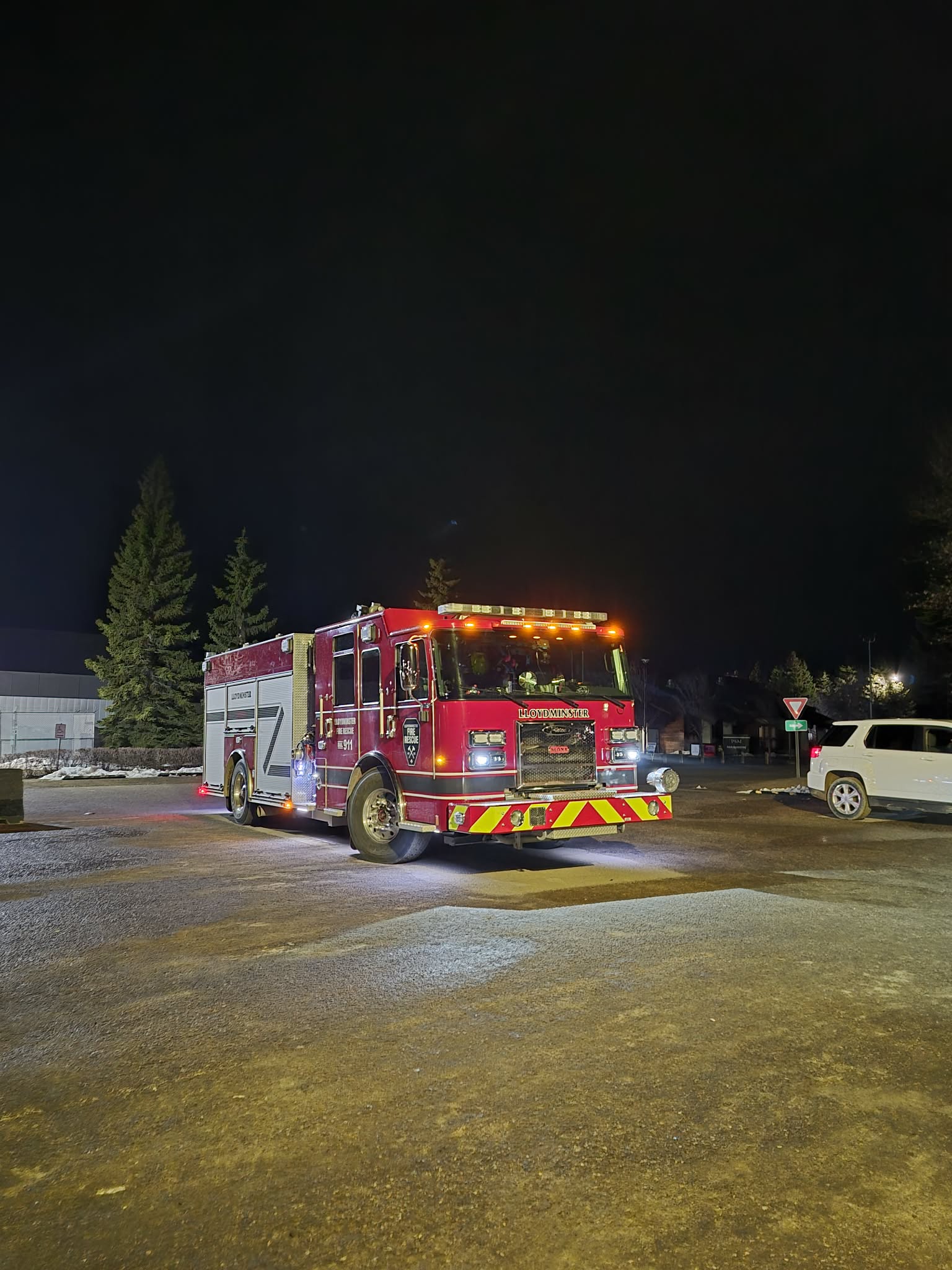
Lloydminster Fire Rescue answered a record 1,393 calls in 2025 – a 24 per cent jump from 1,124 the year before and nearly double the 783 calls logged in 2021.
Fire Chief Bill Heesing presented the department’s annual report to the city’s Governance and Priorities Committee Monday, calling 2025 a landmark year for the service.
“2025 was a year of change,” Heesing said. “Key changes was our staffing model and rebranding of our name to Lloydminster Fire and Rescue.”
On average, the department responded to four calls per day throughout the year.
What they responded to
The 1,393 calls broke down into 100 fires, 495 alarms, 362 medical assists, 256 motor vehicle collisions, and 180 other responses – including elevator rescues, downed power lines, RCMP assists, and public hazard calls.
Structure fires included 27 residential and 15 commercial. Grass and garbage fires accounted for 42 calls, burning complaints for 54, and vehicle fires for 16.
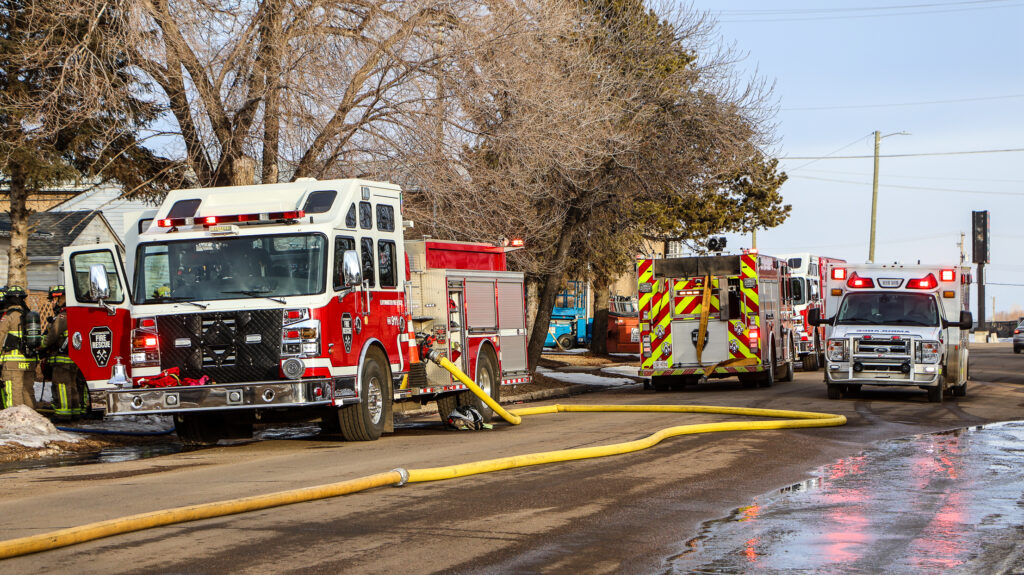

The department also recorded one mutual aid call – the Lloydminster Golf and Curling Centre fire last May – and noted it has used mutual aid from outside agencies only about five times in the last seven years.
Coun. Michele Charles Gustafson asked what was behind a noted decrease in structure fires since 2022 and 2023.
Heesing pointed to community education.
“We’ve been in the schools a lot,” he said. “We provide a lot of information to the schools for them to take home. Our community engagement events, where we’ll set up a table, whether that was at a Bobcats game or at our open houses where we provide that education – I think that’s continuous education and working with the community.”
Charles Gustafson offered her own assessment.
“I really have to commend your open houses,” she said. “When you’re in the moment, you probably don’t remember how to do it. And so that education campaign of making it fun will also trigger how to do it in real life.”
The staffing overhaul
The call volume increase came alongside the department’s most significant structural change in years. On July 1, 2025, Lloydminster Fire Rescue transitioned to full 24/7 staffing at both Station 1 on 47 Street and Station 2 on 59 Avenue.
Before the change, Station 2 relied on paid on-call firefighters on standby – a model Heesing said was increasingly difficult to sustain.
“We really struggled to staff some of those standby shifts,” he said. “And this is the reason that we shifted to the new model. We can guarantee the city we have eight people on duty 24/7.”
The results were immediate. The estimated average total response time from Station 2 for a second alarm call dropped from 17 minutes and 29 seconds before July to 7 minutes and 14 seconds after – a reduction Heesing attributed to cutting what firefighters call “chute time,” the interval between when crews are alerted and when the apparatus starts moving.
“With the staffing of Station 2, it’s decreased the shoot time an estimated eight to 12 minutes,” he said.
Since the new model took effect, Station 2 has handled approximately two-thirds of all incident responses based on its assigned district. Since July 1, Station 1 averaged 258 calls, Station 2 averaged 388, and both stations responded together on 197 calls.
The department now targets an eight-minute total response time – a figure Heesing described as a blend of Alberta’s 10-minute HEERF standard and the six-minute urban average seen in many Canadian cities.
“We feel comfortable that that response time will be met very easily,” he said.
To support the overhaul, 38 positions were filled in 2025, including a new fire chief, two assistant chiefs, a full-time training captain, five captains, nine full-time firefighters, and 20 paid on-call firefighters. Heesing noted the full-time positions were filled from within the existing ranks. The department logged more than 10,000 hours of training – roughly 150 to 200 hours per employee on average.
The medical co-response question
Coun. Jason Whiting raised the department’s growing involvement in medical calls, noting the numbers would only climb in 2026 now that the co-response program was running for a full year.
The department officially took on the Medical First Response program in mid-2025, responding to 296 medical calls between roughly mid-June and the end of December. Those calls are limited to high-acuity incidents – cardiac arrests, overdoses, and what emergency services classify as Delta and Echo calls.
Whiting asked whether the city was being adequately compensated for taking on calls that he suggested the province was responsible for delivering.
“I just want to ensure that we’re not taking over a service that the province is supposed to be providing and we’re not getting the funding,” Whiting said.
City Manager Dion Pollard clarified that the department had been responding to medical calls before the formal program existed – just without any compensation.
“We were responding to these calls before, but we weren’t getting paid for it,” Pollard said. “So that was one of the reasons for getting into a structured process – we were going anyway and not getting any kind of funding for it, so at least now we’re getting something.”
Heesing added that the department retains the ability to declare itself unavailable for co-response calls and is not a guaranteed primary responder – a distinction that matters as conversations about integrated emergency services continue to evolve provincially.
“There’s an interesting dynamic going on in Alberta right now,” Pollard noted, pointing to the City of Red Deer as an example of municipalities getting more involved in ambulance service contracts. “Our ears are tight to the ground in terms of how that will impact both fire and the ambulance sides.”
Mental health supports
Charles Gustafson asked what programs exist to support firefighters dealing with the psychological weight of the job.
Heesing described the department’s peer-to-peer support program – a shared initiative that includes dispatch, municipal enforcement, and fire rescue members, with about 12 trained peer supporters across the group.
“We want to encourage that communication and the conversation,” he said. “And if that’s happening and that person still needs that help, the trained peer members understand what the next steps would be.”
He was direct about the priority behind it.
“I want to make sure my team’s mentally healthy to do the job,” Heesing said. “And one that I’m very excited to be part of.”
Southwest growth flagged as pressure point
The report flags the southwest area of Lloydminster as the department’s next planning challenge. Significant residential and commercial development is anticipated in that corridor, and Heesing said the department is already thinking ahead.
“Recognizing the future community growth anticipated in the southwest area of the city, including both commercial and residential development – again, this is being proactive with service planning,” he said.
Coun. David Lopez asked whether the current district split – which gives Station 2 roughly two-thirds of the city’s geographic response area along the Alberta side – would be redrawn as growth continues.
Heesing said July 1, 2026 – one full year under the new model – would be a natural point to evaluate.
“Maybe by then we’ll have kind of an idea what’ll work or what we need to change,” he said.
Mayor Gerald Aalbers closed by passing along council’s gratitude to the department’s membership.
“They’re first in and last out, as they say,” Aalbers said. “So thank you so much.”