


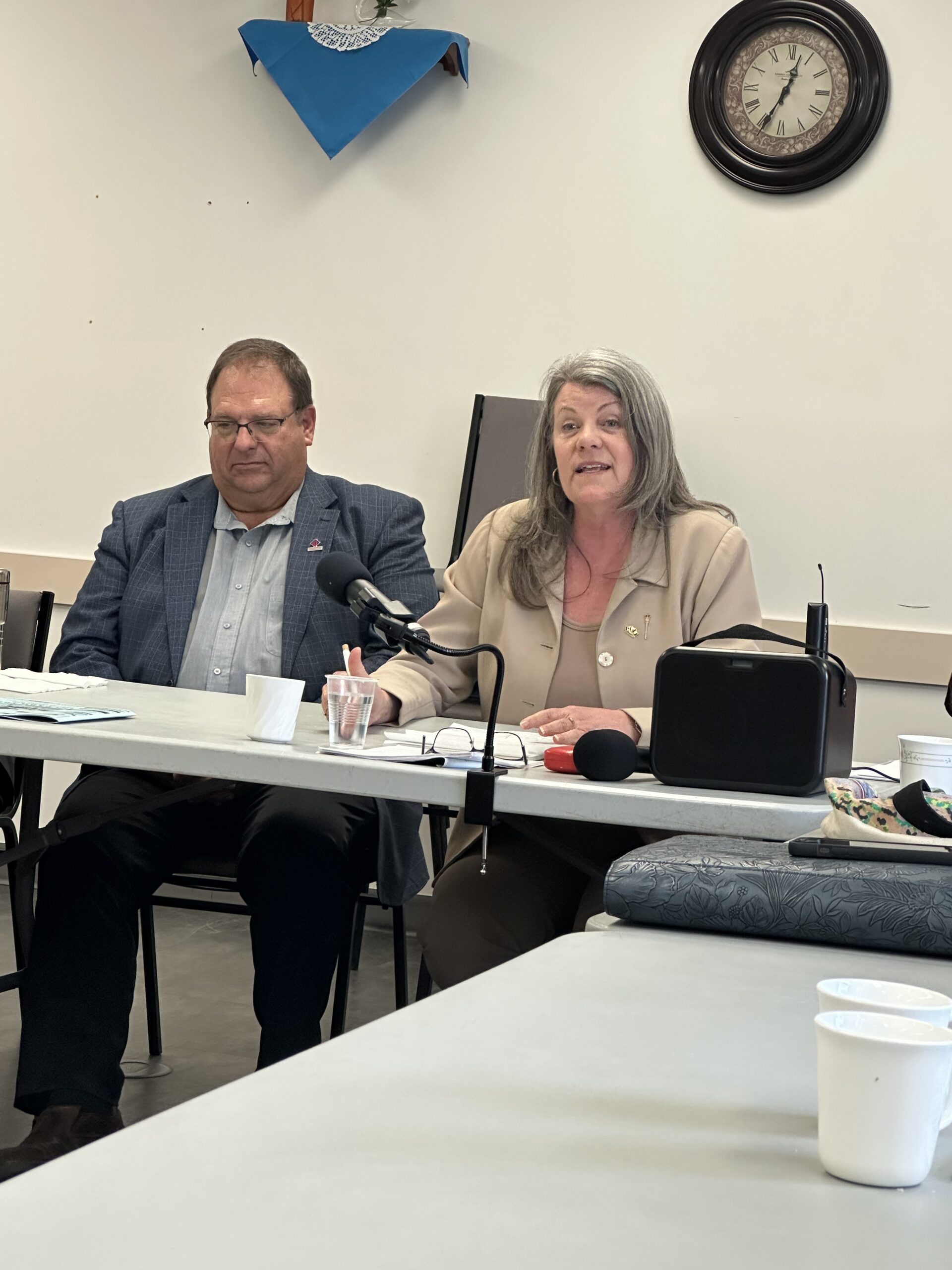
A Lloydminster seniors advocacy group put hard questions to an Alberta NDP shadow minister Thursday, challenging her on a health needs assessment that both provincial governments commissioned but have yet to release, and on decades of inadequate continuing care capacity in the border city.
Lori Sigurdson, the Alberta NDP’s shadow minister for seniors, continuing care, and home care, met with members of the Lloydminster Concerned Citizens for Seniors Care Society. Sigurdson represents Edmonton Riverview and served as Minister of Seniors and Housing under former premier Rachel Notley.
She told the group the research is clear: public continuing care facilities produce the best outcomes for residents, followed by non-profit operators, with private facilities consistently at the bottom.
“We know from research that’s been done extensively that public has the best outcomes for seniors,” Sigurdson said.
She identified staffing as one of the most urgent pressures in the system. Many continuing care workers are precarious employees, she said, often newcomers whose first language is not English, and predominantly women. High turnover means residents frequently don’t see the same faces, which undermines the relationships that quality care depends on.
She also pointed to what she called a significant step backward under the United Conservative Party government: the removal of a standard requiring residents to receive 4.1 hours of direct care per day. That standard had given families a basis for accountability. Without it in legislation, she said, operators can do as they choose and the public has no recourse.
“It takes away the power from citizens,” Sigurdson said.
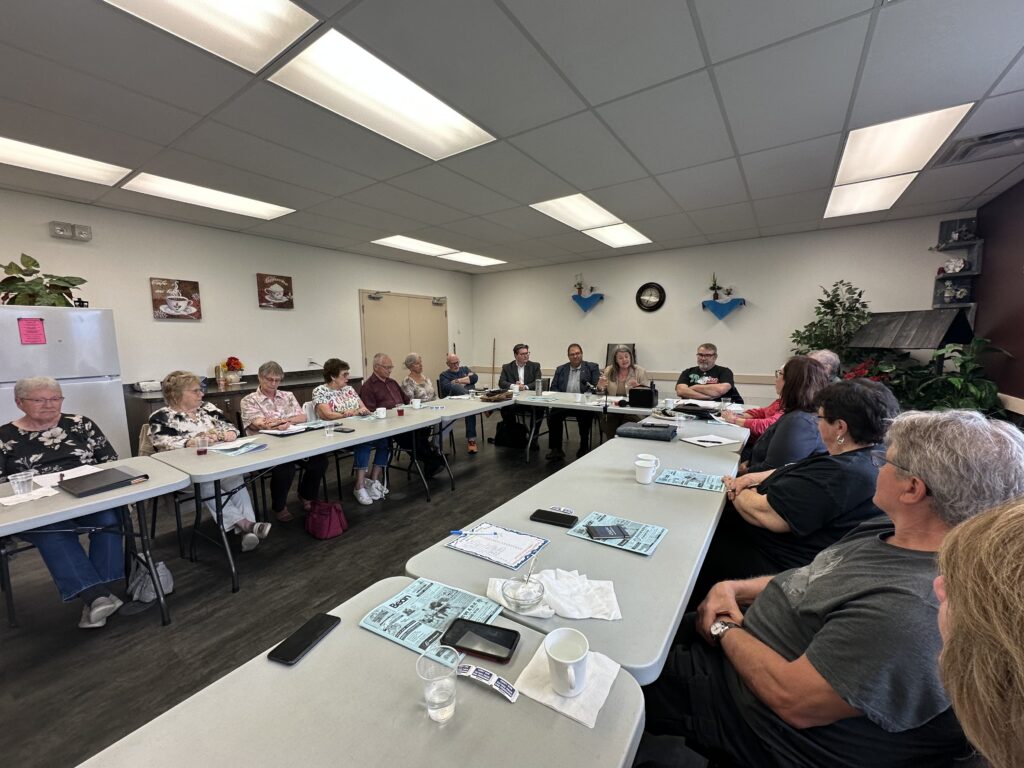
Senior’s speak-up:
The group did not let the visit stay general for long. Rafat Saeed, a physician who had practised in Lloydminster for nearly 50 years, directed Sigurdson’s attention to the jointly commissioned health needs assessment, which both the Alberta and Saskatchewan governments ordered in 2024. The report was delivered to Saskatchewan Health Authority in early January, but has not been released publicly.
Sigurdson said she was not previously aware of the report.
“Both governments?” she asked, when Saeed confirmed the assessment was a joint provincial undertaking.
The group described a pattern of shifting deadlines. They were told the report would be released in December 2025, then January, then spring, then June. No clear explanation has been given for the delays. One member noted that the consulting firm, Cornerstone Group, had briefly posted details about the assessment on its website before the page went offline.
A media FOIP filed with SHA is awaiting response, with a 30-day window closing June 29.
The 2013 iteration of a similar assessment identified roughly $100 million in needed investment for Lloydminster. The community received $3 million.
Ruby Trudel, a member of the group for 11 years, directed some of her sharpest remarks at Saskatchewan’s record on continuing care.
“Saskatchewan is just abdicating their responsibility by having 50 beds that they’ve had since I was eight years old,” Trudel said. “That is just completely inappropriate.”
She told Sigurdson that when local beds fill up, Lloydminster seniors are sent as far as 150 kilometres away. The longest displacement she was aware of lasted a year. The person who returned, she said, came back changed.
“It’s hard to imagine that that is acceptable. And what other part of the population would we do that to?”
Saeed put the community’s frustration another way. Lloydminster, he said, has always operated as one city.
“We are not Albertans, we’re not Saskatchewanites, we are Lloydminsterites,” he said. “We pride ourselves in seamless.”
He noted the school system on both sides of the border has historically delivered comparable services regardless of which province a student lives in, and said the same standard should apply to seniors care.
Sigurdson was candid about what she can and cannot do in opposition. She can ask questions, raise issues in the legislature, give member statements, meet with groups like this one, and attempt to generate public pressure. She pointed to the UCP’s use of the notwithstanding clause against teachers as an example of how the government has responded to pushback before.
“Sometimes they listen, sometimes they don’t,” she said.
She noted the next Alberta provincial election is scheduled for October 2027, and suggested the period leading up to an election is historically a productive one for advocacy.
With the local MLA for Alberta resigning and the one on Saskatchewan not yet committed to running again, members of the group flagged that as an opportunity to engage incoming candidates on the continuing care file before they take office.