




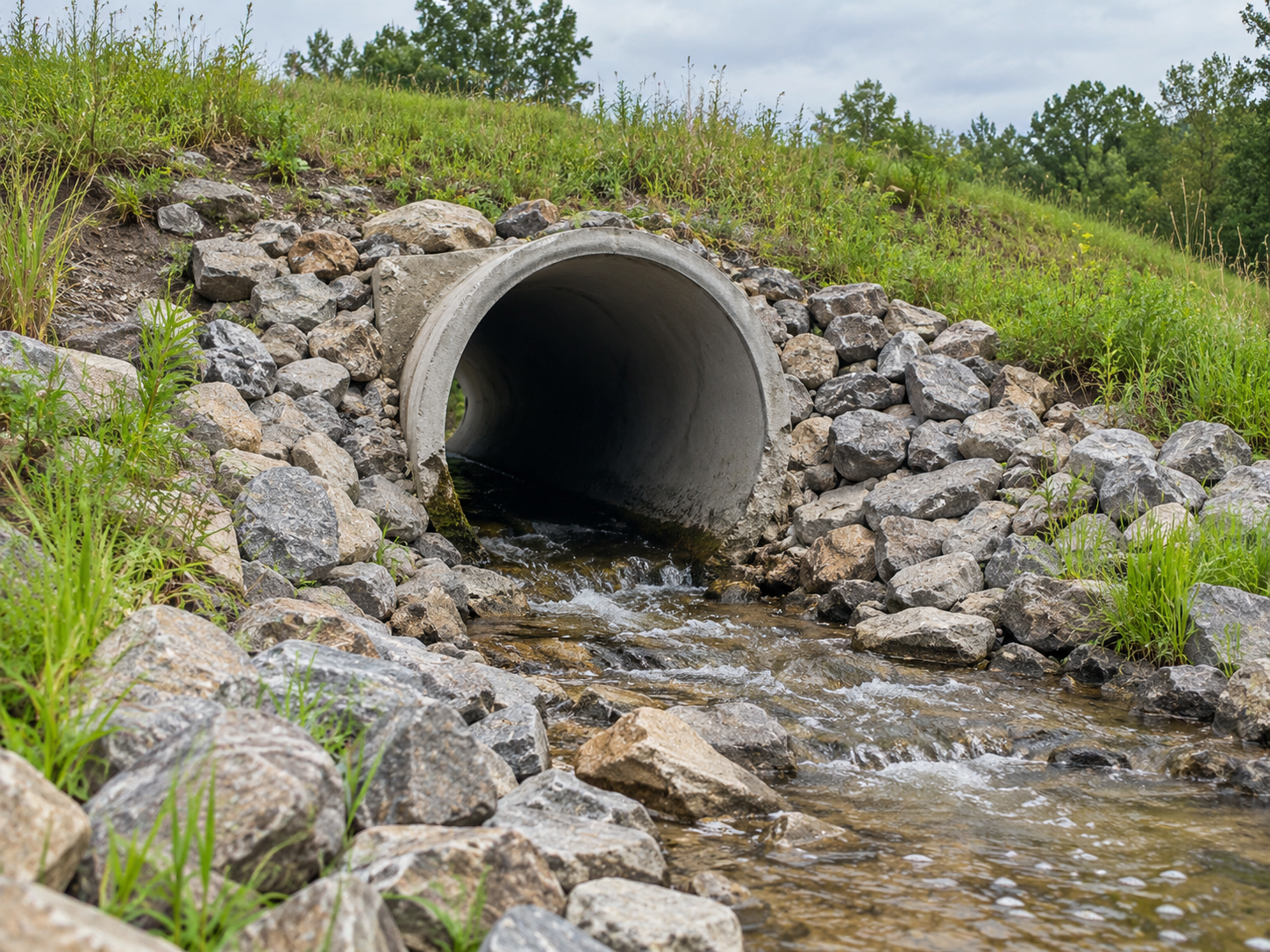
A 131-foot (40-metre) culvert replacement will set the City of Lloydminster back nearly half a million dollars. Council approved the $449,258.20 contract earlier this month after four councillors questioned the price. Administration says the pipe must handle runoff from a deep ravine on the only road to the river pump house.
Council also approved $150,000 from the Stormwater Services Capital Reserve and a $44,925.82 contingency. Together, the commitments reach $494,184.02, not including GST.
Coun. Jim Taylor moved both motions, and Coun. David Lopez seconded them. Both carried.







What the project is
The city draws its drinking water from the North Saskatchewan River. The intake sits about 32 kilometres (20 miles) north of Lloydminster.
The access road to the river pump house crosses a ravine. Rusway Construction Ltd. will replace an 1,800-millimetre (5.9-foot) corrugated steel culvert there with a 1,950-millimetre (6.4-foot) concrete pipe. Crews will also lay large rocks and synthetic fabric to stop erosion, then rebuild the road.
Teague Smith presented the report for city administration. He said the City issued the tender on Sept. 17 and closed it on Oct. 1. It received five bids.
Rusway’s bid was the lowest at $449,258.20. The next lowest, from Nu Edge Construction Ltd., was $501,275. The highest was $1,434,215. All figures exclude GST.
Construction is expected to start this fall and finish by winter, Smith said.
How the budget changed
The City’s 2025 capital budget listed the project at $770,000 but funded only $250,000. A city administration member told council administration cut the request before council saw it and planned to line the existing pipe instead.
Council added $100,000 in the 2026 capital budget to cover rising costs, the member said. A quote from a lining company then came in well above expectations, so administration tendered a full replacement.
Tender prices came in higher than expected, said Smith. He pointed to market conditions, inflation and challenges at the site.
The member said about $300,000 was already approved. The two budgets add up to $350,000, so the $150,000 top-up brings the project to $500,000.
The money comes from a reserve, not new tax dollars, the member said. The member added that reserve money is, in theory, all tax dollars.
What councillors asked
Coun. Justin Vance opened the questions. He called it one of the most expensive culverts he had seen installed and asked what drove the cost.
Lopez said the price made him swallow hard. He said his own farm culverts never cost more than $10,000.
“I don’t know how I would justify this to the public saying a $450,000 culvert,” said Lopez.
He asked why the City needed a bigger pipe than the culverts on the Highway 17 passing lanes. He also asked about using two smaller steel culverts.
Coun. Jason Whiting said the word “culvert” may have hurt administration’s case.
“I think the idea of calling it a culvert probably hurt us,” said Whiting.
Whiting asked whether the City could shorten the pipe or install two. He also asked whether council could table the item to look at other access.
Taylor asked whether the City could abandon the road and reach the pump house another way. He also asked whether environmental rules applied and whether any senior government would share the cost.
Vance asked whether provincial erosion-management grants could help. Smith said none had been identified, though staff are working with the City’s grants coordinator.
Coun. Michael Diachuk, who chaired the meeting as acting deputy mayor, asked how long each material lasts. Smith said concrete lasts about 90 years and steel lasts 60 to 70.
How administration defended the cost
Smith said size drives the price. He said the new pipe is 1.95 metres (6.4 feet) across, and he stands 1.85 metres (6.1 feet) tall.
“I could stand in the middle of it and I’d have four inches of clearance over my head,” said Smith.
He said the ravine drains a large catchment area. Natural springs upstream keep water flowing even at minus 40, he said, which raises the risk of ice damming.
Smith said the larger opening is about 17 per cent greater in area. Concrete also moves water more efficiently than steel, he said.
A city administration member said many quarter sections drain into the ravine. After heavy rain, the member said, the water arrives at the crossing all at once.
The pipe is about 40 metres (131 feet) long. Smith said the road sits about 5.5 metres (18 feet) above the ravine floor. The slopes on each side must follow a three-to-one or four-to-one ratio.
Shortening the pipe would mean regrading the road, Smith said. The savings would likely go to earthworks.
Lopez asked whether guardrails could allow steeper slopes. Smith said that would require geotechnical work to check slope stability.
Smith also raised a cost that changed one councillor’s view. The City’s raw water line crosses the drainage channel at the point where the culvert discharges.
Crews must line the channel with rock on both sides to protect that line, Smith said.
“That changes my opinion,” said Lopez.
Lopez said he still wants every dollar spent carefully. He asked administration to include such costs in future reports.
The alternate route
The pump house has a second route through private land, Smith said. Water treatment plant staff can use it during construction.
Diachuk said he had spoken years ago with the owner, who did not want city vehicles crossing the property. A city administration member said the City does not own that road or land.
The member said the City would also have to worry about winter maintenance. Staff check the crossing often, the member said, and it has caused problems for years.
The member said a delay could have a major effect on finishing the work in 2026.
What happens next
Administration will study the private route and consult the water treatment plant operator, a city administration member said. It will report back to council.
The member said another large crossing, west of the city, will appear in the November budget. Its early estimate is about $750,000.
Read More: Council backs taxi program over bus system