



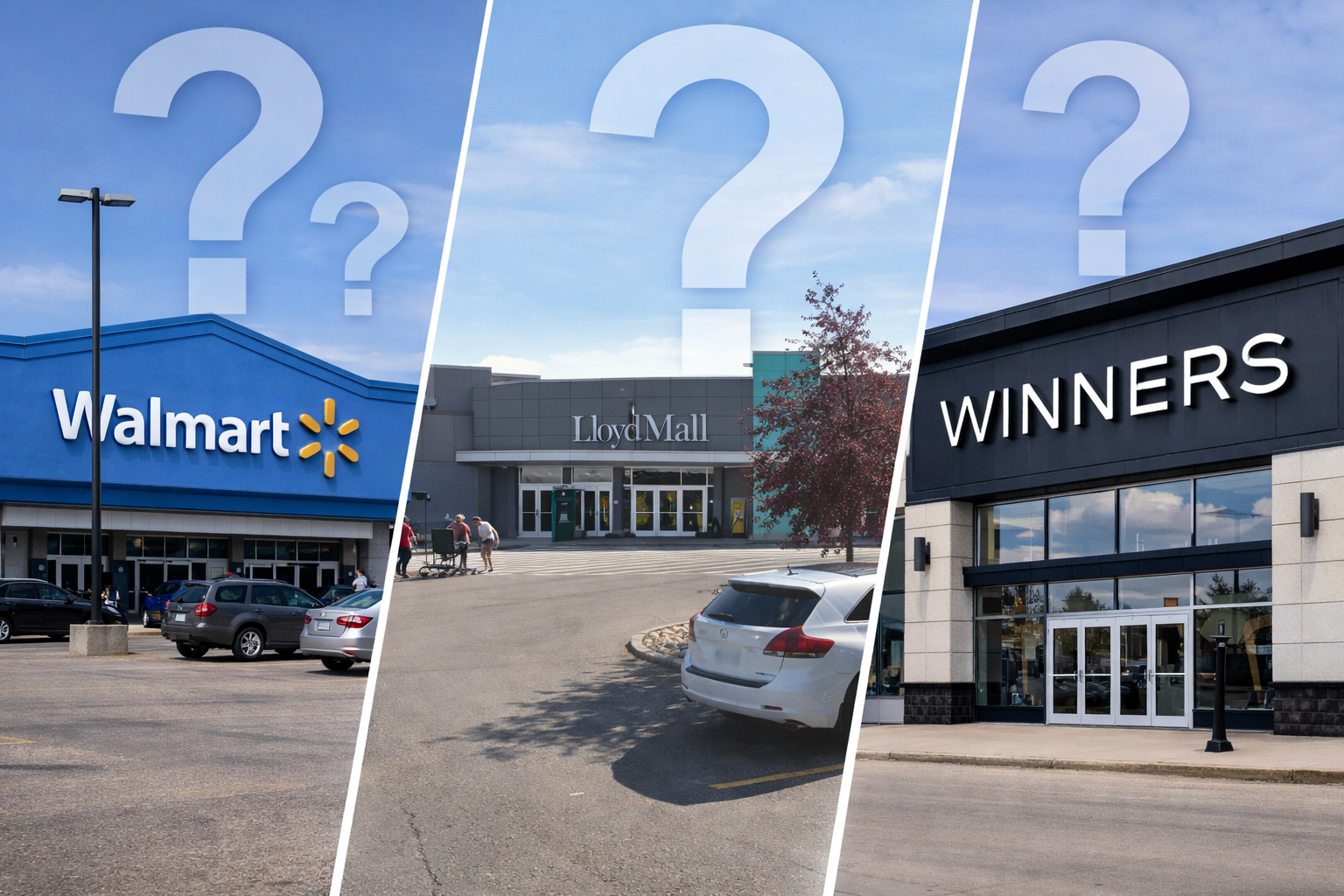
After reading about a few recent posts on social media about run-ins at our local Walmart, it got me thinking. Do you know where your teen is? What they might be up to?
It’s not just about one interaction, but about a pattern people say they’re seeing, and the stories behind it are strikingly similar.
Groups of teens hanging around, not really shopping, grabbing balls from the sports section, tossing them around the store and leaving items behind. Treating the place more like somewhere to pass time than somewhere people are trying to run a business.




When asked to stop, the response wasn’t immediate escalation. In some cases, it even started off polite. However, the behaviour didn’t change, and that’s where it starts to get frustrating. I can’t imagine what kind of self-entitlement leads to that kind of attitude, but more on that in a bit.
In one account, teens were sitting on patio furniture, throwing a ball back and forth and hitting nearby displays. When it was pointed out that something could get damaged, the response was dismissive.
“They’re plastic.”
Then things shifted, in a direction that seems to be an easy scapegoat, and one that, in my experience, gets used far too often.
What started as frustration over behaviour turned into something more uncomfortable. One of the teens began asking, “Is it because I’m brown?” repeatedly, completely changing the tone of the interaction. It raises a fair question, what would make a teen jump to that conclusion? Is racism really that prevalent in our community, or is it sometimes used as a way to avoid accountability?
Either way, at that point it stopped being about what was happening in the store and became something it never should have been.
According to the posts, the group followed the person through the store until staff stepped in. Employees reportedly said they had seen the same group before, hanging out, causing issues and not buying anything.
And if even some of that is accurate, it points to something bigger than one bad interaction. It points to a pattern. But that’s not the whole picture, because in those same posts, from the same person, there was another story from a different day at the same store.
This time, it was three teenage girls walking in together. One had a broken foot, struggling in a large boot, while the other two were on either side of her helping her move, step by step, making sure she didn’t fall. No scene, no disruption, just quiet support.
That moment stuck just as much, because it’s a reminder that the story isn’t as simple as “teens are the problem.” It rarely is.
At any given time, in the same place, you’ll find both. The frustrating behaviour that draws attention, and the everyday moments that don’t. Social media just happens to highlight the worst in most of these cases. It’s proven psychology, negative experiences travel faster, stick longer and are usually what people remember.
But both sides of this highlight a bigger issue in Lloydminster, where exactly are these kids supposed to go?
For a lot of teens in this community, there isn’t really a place to just exist, somewhere indoors, safe and free, where they’re actually welcome to spend time without being expected to buy something. Some churches run after-school programs and there are organized activities if you’re signed up and scheduled, but for the in-between time, there’s not much.
So they end up where there is space, Walmart, the mall, other big box stores. Places that were never designed for that, and that’s where the friction happens.
From a business perspective, it’s understandable. Staff and customers shouldn’t have to deal with disruption, damage or feeling uncomfortable while they’re trying to shop or work. But from a broader perspective, it raises a different question. If teens are consistently ending up in these spaces, is it just about behaviour, or is it also about a lack of somewhere else to go?
Both things can be true. Poor behaviour should be called out. Respect matters.
But it’s also worth saying this. Behaviour doesn’t just appear out of nowhere. Some of it comes down to parenting, expectations and accountability — the basics that are taught long before a group of teens ever walks into a store. At the same time, it’s not the only factor.
Growing up, I couldn’t imagine what would be waiting at home if word got back I was being disrespectful or causing problems. In hindsight, that probably stopped me from making a few worse decisions. Being from the middle of nowhere, with no cell phones, dial-up internet and the nearest neighbour nearly a kilometre away, you learned how to entertain yourself. You didn’t go looking for somewhere to be a pain in the ass to other people. Most of us weren’t raised that way.
Peer pressure plays a role. Environment plays a role. And so does the reality that a lot of kids don’t have a place to go, so they end up pushing boundaries in the places they do have access to.
Because if the only places left for young people to gather are businesses, then this isn’t just a Walmart issue.
It’s a community one.
And until there’s somewhere else for them to go, it’s probably not going to change.
Read more: Opinion: Could Costco help solve Lloydminster’s unhoused issue?