




Lloydminster Hospital lost its intensive care unit to staffing challenges. A health assessment says the hospital still does not meet Saskatchewan’s legal standard for regional hospitals – and critically ill patients are being flown out by air ambulance, weather permitting.
Lloydminster Hospital once had an intensive care unit.
Staffing challenges led to its closure. The ICU was downgraded to a Special Care Unit. And there it has stayed.




“While the hospital once had an ICU, staffing challenges led to the loss of the ICU and downgrading into the SCU,” the Lloydminster Health Service Needs Assessment states.
That sentence is in a 261-page report two governments received in December 2025. It was not in the four pages they released to the public.
What the health assessment says the hospital has now
The hospital currently operates a Special Care Unit, also referred to as a High Acuity Unit. The assessment is precise about what it can and cannot do.
“While the SCU provides short-term stabilization, it cannot deliver sustained ventilation or manage complex cases over longer periods,” the document states.
In plain terms: if you are critically ill and need more than a day or two of intensive support, you cannot get that care in Lloydminster.
“Patients who require longer-term ventilation or complex ICU care are transferred to facilities, often via air ambulance,” the assessment states. “These transfers require coordination and are dependent on weather and visibility, which create challenges for timely and appropriate care.”
Weather permitting. That is the standard of critical care access in Lloydminster in 2025.
The assessment also notes these long-distance transfers “place additional demand on external facilities that are already managing significant volumes, and create delays for patients and families locally.”
The transfers
The assessment reviewed transfer data between January and May 2025. In those five months, 29 patients were transferred out of Lloydminster Hospital for critical care services at an Alberta facility.
Seven had cardiac-related diagnoses. Six had neurological diagnoses, including stroke. One had a urology diagnosis. The remaining 15 had medicine-related diagnoses.
“Examples of these medical diagnoses included septic shock, respiratory distress, and head injury trauma, all requiring very urgent and intensive care that could not be serviced at Lloydminster Hospital,” the assessment states.
Twenty-nine transfers in five months. Septic shock. Stroke. Head trauma. All leaving by air ambulance. All subject to weather.
The staffing problem
The Special Care Unit is staffed by skilled nurses. The assessment is careful to acknowledge that. It is equally careful about what those nurses cannot do.
“While the SCU is staffed by skilled nurses, they are not ICU-trained and do not work at ratios that meet ICU standards,” the document states. “Recruiting and retaining ICU-qualified staff has historically been difficult and will continue to be difficult.”
The assessment identifies dual-licensing requirements as a contributing barrier. A nurse seeking ICU-qualified work in Lloydminster must navigate two provincial licensing systems. The assessment identifies this burden as a structural problem unique to this community, one that compounds an already difficult national recruitment environment.
What Saskatchewan law requires
Here is the part that makes the absence of an ICU more than a service gap.
“The lack of a designated ICU represents a significant service shortfall, particularly as Saskatchewan’s provincial legislation requires regional hospitals to provide this capacity,” the assessment states.
Lloydminster Hospital is designated as a regional hospital. Regional hospitals are required by law to have ICU capacity. Lloydminster does not meet that standard.
Two governments have known this since December 2025.
This is not the first time the problem has been identified
A 2013 health assessment commissioned by the same two governments listed intensive care as Priority 4. It recommended expanding the then three-bed Specialty Care Unit to a four-bed ICU immediately, with expansion to eight beds within the 15-year planning timeframe.
That 15-year window closed in 2028.
In 2025, the hospital still does not have a designated ICU. The new assessment is recommending five beds as a starting point.
In 2013, when Lloydminster’s population was 27,804 and its catchment area held 72,498 people, the report compared the city’s three critical care beds against comparable cities. Fort McMurray had seven. Grande Prairie had six. Medicine Hat had 10. Prince Albert had eight.
Lloydminster had three.
The 2025 assessment found that number has not changed in any meaningful way.
What the health assessment recommends
The 2025 assessment recommends developing a five-bed regional-level Tier 4 ICU at Lloydminster Hospital.
“Developing a five-bed regional level ICU would bring services into alignment with provincial requirements for regional hospitals, reduce reliance on long-distance transfers, and ensure more equitable access to critical care for residents of Lloydminster and the surrounding region,” the document states.
The projected need by 2040 reflects “a 67 per cent increase in high-acuity inpatient utilization compared to 2024,” the assessment states.
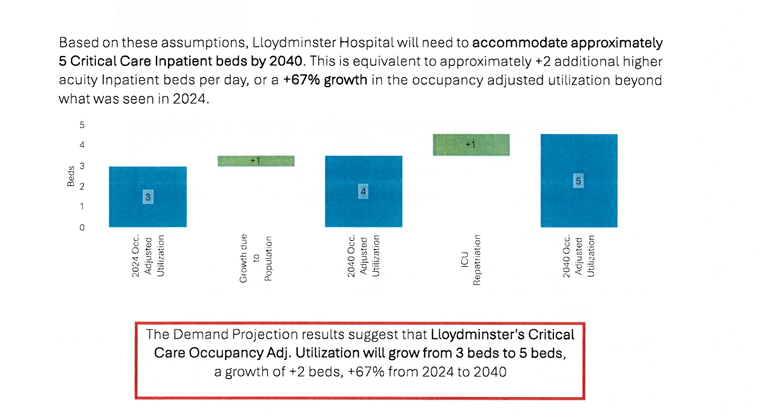
The proposal would convert the existing Special Care Unit rather than build from scratch. The unit would be led by internal medicine physicians, with remote intensivist consultation available for complex cases. Emergency department nurses would be cross-trained into ICU roles to build staffing depth across both units.
The model would not function as a tertiary ICU. Patients with specialized-service diagnoses would continue to be transferred. But patients with medicine-related diagnoses, which accounted for 15 of the 29 transfers in early 2025, could stay closer to home.
“Patients could also stay closer to home, improving family access,” the assessment states.
That line should not need to appear in a government-commissioned report in 2025. It should have been acted on in 2013.
Ministry of Health response
BorderPulse contacted the Saskatchewan Ministry of Health and the Alberta Ministry of Primary and Preventive Health Services with four specific questions about the ICU gap. Brandi Boxall a Communications specialist with the Saskatchewan Ministry of Health, responded on behalf of both provinces.
Boxall said the assessment would inform future planning but carries no commitment.
“The findings and recommendations referenced in the Lloydminster Health Service Needs Assessment will be taken into consideration by the Ministry of Health for future planning,” Boxall said. “The Needs Assessment is meant to be a guiding document to assist in informing potential healthcare service improvements in the Lloydminster area but balanced against the Provincial System Planning.”
Boxall said the current Special Care Unit continues to serve patients requiring a higher level of care, and that transfers to tertiary centres are consistent with how other regional hospitals operate.
“Certain specialized critical care services that patients may require are only available in tertiary care hospitals in Regina and Saskatoon such as cardiac, neurology, or head injury needs,” Boxall said. “Other regional hospitals would also be required to transfer patients with similar conditions to tertiary hospitals.”
Boxall confirmed no ICU decision has been made.
“Decisions about future service delivery and the operationalization of an ICU have not been finalized,” she said.
BorderPulse asked four questions. The response did not answer any of them directly.
The government did not address the assessment’s finding that Saskatchewan’s provincial legislation requires regional hospitals to provide ICU capacity and that Lloydminster does not currently meet that standard. It made no commitment to fund the recommended five-bed regional ICU. It offered no plan to reduce the community’s dependence on weather-dependent air ambulance transfers. It did not address the dual-licensing barriers identified as a barrier to recruiting ICU-qualified nurses.
Tomorrow: ER wait times
Read the full series: Lloydminster Health Needs Assessment: Investigation




Build it they will come, don’t have it they will leave . Many families that look to move here don’t because of the lack of health care, Many have moved away because of our complex health care . Lack of an icu is a big deal!