




According to the health report – Lloydminster Hospital’s emergency department handles 23,000 visits a year with single-physician coverage, wait times double the provincial peer median, and a fast-track zone that sits empty.
In 2024-25, roughly one in every six patients who walked into Lloydminster Hospital’s emergency department left without seeing a doctor.
That is approximately 3,500 people a year. Gone. Unseen.




The Lloydminster Health Service Needs Assessment is direct about why.
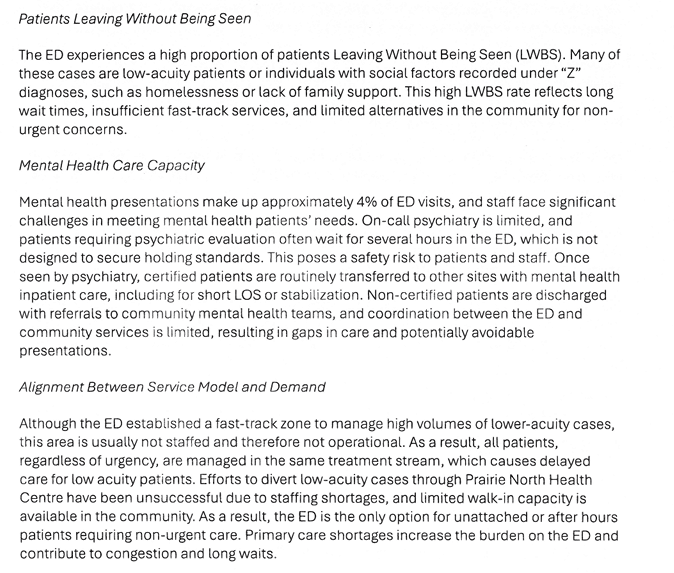
“The ED experiences a high proportion of patients leaving without being seen,” the document states. “This high LWBS rate reflects long wait times, insufficient fast-track services, and limited alternatives in the community for non-urgent concerns.”
Lloydminster ranked second highest among peer Saskatchewan hospitals for its rate of patients leaving without being seen. Only Battlefords Union Hospital in North Battleford was higher.
The peer median for similar hospitals is four per cent. Lloydminster’s rate is 15 per cent.
One physician for 14 spaces
The emergency department has 14 treatment spaces. On most shifts, one physician covers all of them.
The assessment identifies this as a central driver of the wait time problem.
“One provider serving all 14 spaces, delays in specialist consultations, or access to inpatient beds” are identified as the primary causes of prolonged stays, the document states.
Average wait time in Lloydminster’s ED from registration to disposition is now 5.8 hours. In 2019-20, it was 3.7 hours. That is two additional hours every patient now waits compared to five years ago.
The provincial peer median for comparable Saskatchewan hospitals is 2.6 hours.
Lloydminster patients wait more than twice as long as patients at comparable hospitals. The assessment confirms the hospital has the highest emergency department length of stay among its peers.
The assessment also notes patient acuity is not the reason. Lloydminster’s proportion of lower-acuity CTAS 4 and 5 patients is similar to peer hospitals. The Canadian Triage and Acuity Scale ranks emergency patients by urgency from Level 1 (resuscitation) to Level 5 (non-urgent). Levels 1 and 2 are life-threatening. Level 3 can deteriorate quickly. Levels 4 and 5 are lower-acuity conditions that could be managed elsewhere.
The patients are not sicker than average. The system is just slower.
Patients health conditions are getting more acute
Total emergency department visits have actually declined over five years, from approximately 25,300 in 2019-20 to 23,800 in 2024-25.
But the patients coming in are sicker than they used to be.
The proportion of the most urgent CTAS 1 and 2 patients increased from 11 per cent to 13 per cent over that period. CTAS 3 patients, those with conditions that could deteriorate, grew from 29 per cent to 33 per cent of all visits.
Fewer patients. More serious cases. Longer waits. One physician.
The hospital admission rate from the ED also increased, from 7.8 per cent to 8.3 per cent, meaning more patients who come to the ED now need to be admitted than before.
The fast-track zone that does not work
The hospital has a designated fast-track zone for lower-acuity patients. It exists on paper. In practice, it sits empty.
“Although the ED established a fast-track zone to manage high volumes of lower-acuity cases, this area is usually not staffed and therefore not operational,” the assessment states. “As a result, all patients, regardless of urgency, are managed in the same treatment stream, which causes delayed care for low acuity patients.”
Lower-acuity patients who could be seen quickly in a functioning fast-track zone instead wait in the same queue as the most critical cases. Everyone waits longer. Some leave.
The social crisis showing up in the data
Behind the raw numbers is a pattern the assessment flags directly.
Of the 3,500 patients who left without being seen in 2024-25, roughly 800 had a “Z” diagnosis, the medical code used when someone is accessing the hospital not because they are physically ill but because of social factors such as homelessness or lack of family support.
These visits have grown. From approximately 1,000 annually in 2019-20 to approximately 1,400 in 2024-25.
“The ED visits with a ‘Z’ diagnosis have increased from approximately 1,000 annual visits in 2019-20 up to approximately 1,400 in 2024-25, suggesting a potential increase in social issues or systemic gaps in the community being served,” the assessment states.
The emergency department is absorbing a social crisis as well as a medical one.
What the assessment recommends
The assessment recommends introducing Physician Assistants during peak hours to support the single physician, reducing wait times and improving throughput. It projects this change alone could bring average wait times closer to the peer median of 2.6 hours.
It recommends embedding a dedicated Mental Health Nurse in the emergency department and upskilling ED physicians in psychiatric assessment. It recommends a Mental Health Short Stay Unit within the ED footprint for 24 to 48-hour stabilization.
It recommends establishing a Primary Access Clinic offsite at a primary care location, operating from 3 p.m. to 7 p.m., to give low-acuity patients a next-day appointment option instead of an emergency department visit. The assessment projects this could reduce the LWBS rate from 15 per cent down to seven per cent.
“Gap: The ED manages approximately 23,000 visits annually, with increasing acuity and a 12 per cent LWBS rate,” the assessment states. “Single-physician coverage, lack of urgent care alternatives, and insufficient mental health supports contribute to inefficiencies and patient risk.”
By 2040, the assessment projects Lloydminster’s emergency department will need to accommodate approximately 25,700 annual visits, an eight per cent increase from 2024 levels.
That is 1,900 more visits a year arriving at a department that is already at its limit.
This is not the first time the pressure on Lloydminster’s emergency department has been documented. A 2013 health assessment commissioned by the same two governments recorded approximately 40,000 annual ED visits and called for immediate primary care improvements to reduce unnecessary emergency department use. Twelve years later, visits have declined to 23,800 — but wait times have nearly doubled and the proportion of critically ill patients has grown. The pressure did not ease. It concentrated.
Government response
BorderPulse contacted the Saskatchewan Ministry of Health and the Alberta Ministry of Primary and Preventive Health Services with four specific questions about emergency department conditions at Lloydminster Hospital. Dale Hunter, Senior Media Relations Consultant with the Saskatchewan Ministry of Health, responded on behalf of both provinces.
Hunter said the ministry is committed to improving health care in the Lloydminster area.
“The Saskatchewan Ministry of Health is committed to working closely with our Alberta counterparts to provide consistent, high-quality health care services for all residents in the Lloydminster catchment area,” Hunter said. “We want residents in the Lloydminster area to receive the right care as close to home whenever possible.”
Hunter said the assessment identifies opportunities for improvement in patient flow, primary care support, and community-based care, and that the findings will inform future planning.
The ministry pointed to its Patients First Health Care Plan as an existing framework, citing actions underway including enhancing nurse practitioner roles in emergency rooms, building primary care teams, increasing medical school seats, and removing administrative barriers.
“Patients remain at the heart of every decision we make,” Hunter said.
BorderPulse asked four questions. The response did not answer any of them directly.
The ministry did not explain why the hospital’s fast-track zone has sat unstaffed and non-operational. It did not provide a plan to bring Lloydminster’s emergency department wait times, currently more than double the provincial peer median, into line with comparable hospitals. It made no commitment to fund a Primary Access Clinic. It did not address whether Physician Assistants would be added during peak hours to relieve single-physician coverage across 14 treatment spaces.
The Alberta government provided the following statement:
“This assessment was commissioned to help us deliver strong local health services for Lloydminster residents now and into the future.
We are working with Saskatchewan and local health-care partners to review the findings and use them to strengthen services in the Lloydminster area over the coming years. This includes improving access to care, supporting primary care, enhancing patient flow, strengthening system coordination, and planning for future population growth and an aging population.”
They also did not answer any of the specific questions.
Tomorrow: what the assessment found about Lloydminster’s seniors care system.
This is the next part in a multi-part investigative series revealing what they don’t want us to know about the Lloydminster Health Needs Assessment.
Read the whole series – Lloydminster Health Needs Assessment: Investigation