




This is the weekly opinion column by owner/founder of Border Pulse.
There’s a version of this business that used to be simple. You wrote the story, put it in the paper, and people paid a quarter to find out what happened. That version is gone, and it isn’t coming back. What’s replaced it is a lot more complicated, and most readers have no idea how complicated it’s gotten.
Start with the headline itself. Ten years ago, a headline’s only job was to tell you what happened. Now it has to do that while surviving a platform that buries you if you tell too much, and an algorithm that punishes you if you tell too little. Add Bill C-18 on top, the federal law that pushed Canadian news links off Facebook and Instagram, and you get an industry where the old rule of giving away the whole story in the first line just doesn’t apply anymore. We can’t post a direct news link on Facebook without it vanishing. So we build around it. Linktree pages, redirects, careful wording. It’s not a workaround because we’re trying to trick anyone. It’s a workaround because the platforms decided Canadian news doesn’t get to travel the normal way anymore.




Here’s where it gets interesting, though, and where I want to draw a line between two very different reasons a newsroom might ask you to click twice.
One reason is C-18. Every outlet in this country is boxed in the same way. If you’ve noticed local papers getting cagier with their Facebook posts lately, that’s why. Nobody chose that.
The other reason is a lot less defensible, and it’s worth understanding as a reader because it changes how much you should trust what you’re looking at.
Here’s an example. I worked for an outlet in Sault Ste. Marie that mastered this, and it’s something I promised myself I’d never do again. It happens across the country, and it happens right here in our region too. Some national and local news outlets have built their entire digital pathway around extra clicks that serve no one but the pageview counter.
Example. Facebook -> Linktr.ee -> Website -> Full paper page (SSM and many others). Vs. Facebook -> Linktr.ee -> paper hosting site.
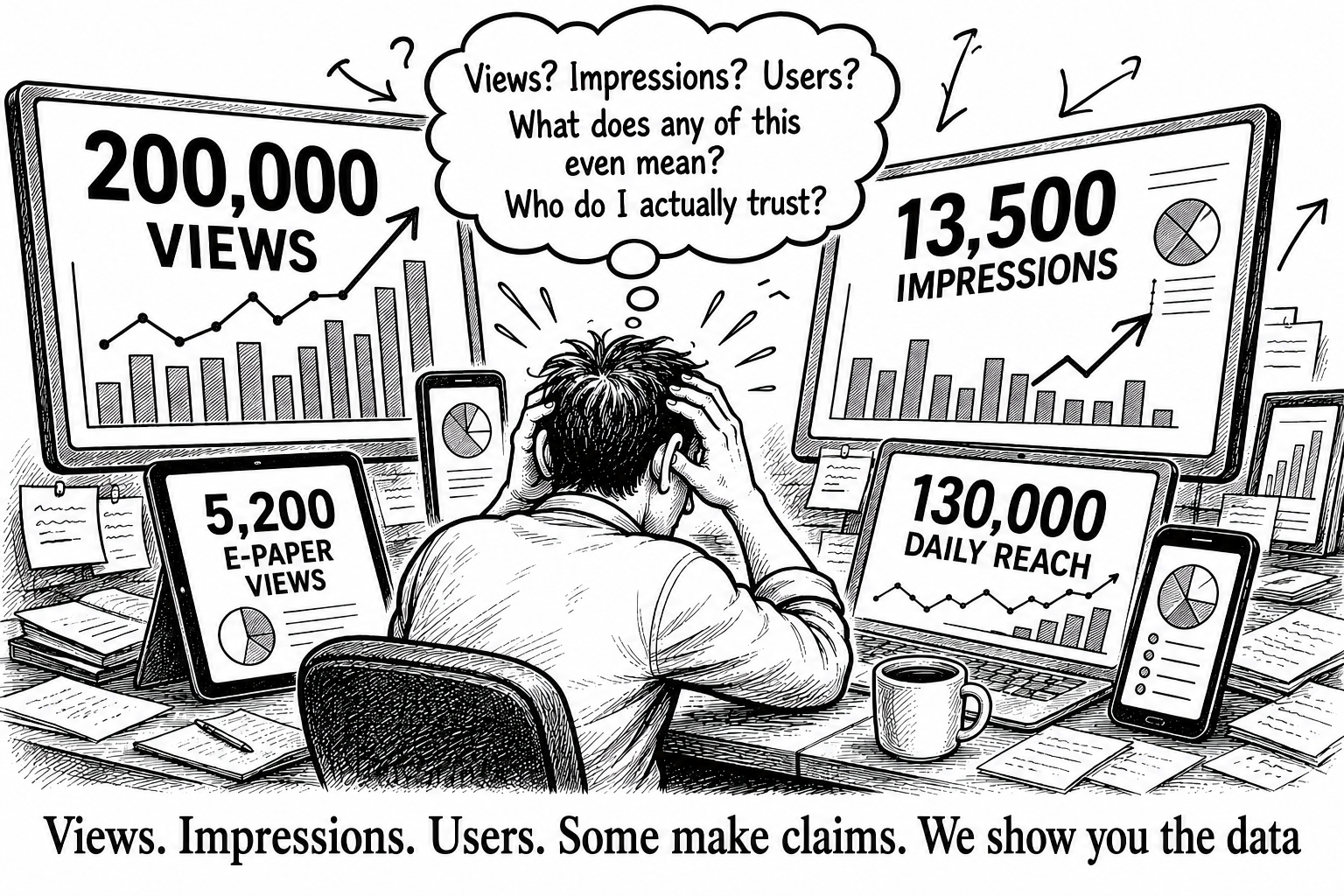
That’s not an accident, and it’s not a technical limitation. That’s a business decision, and it’s one built to inflate traffic numbers for advertisers who are paying based on impressions and click counts they have no way to verify for themselves. The second option, is much cleaner for the customer or reader in this case. Same goes for advertising, flyers and any other way some can find to generate another impression.
Compare that to how we’ve built it. Click our Linktree, you land on the story. Click an ad on our site, you land on that week’s paper, no detour. One click, one destination, every time. The only time option one will appear on my site is if the linktr.ee has too many stories on it, then, you have to go to the main page, it’s not professional or practical to have 3 weeks of stories my readers have to search through to find what they were looking for. The homepage search function is a much better way to do that.
It’s a slower way to build a system, because it doesn’t manufacture extra numbers out of nowhere. It’s also the only version that respects the person on the other end of the click, and the only version that hands an advertiser a number they can actually stand behind.
I bring this up not to score points, but because it says something true about where local journalism is headed. The outlets that survive the next decade won’t be the ones that figure out how to squeeze one more click out of a tired reader. They’ll be the ones that earn enough trust that the reader comes back tomorrow without being tricked into it.
When we launched in November 2025, there wasn’t a version of this in Lloydminster. No one was doing hyper-local, digital-first, no-nonsense coverage that didn’t make you sit through a maze to get to the story. Eight months later, we’re the most-read and most-followed news outlet in this city. I’m not saying that to gloat. I’m saying it because it’s the actual answer to a question a few advertisers and readers have started asking me: how did a one-person operation with a laptop and a camera get here this fast?
The answer is boring, and it’s the same answer it’s always been. We told the truth, we made it easy to find, and we didn’t make anyone jump through hoops to read it. That’s the whole business plan. It still works, even with C-18 in the way, even in an industry that’s found a hundred new ways to complicate something that used to be simple.
We built it this way on purpose, and we’re not changing it just because we can afford to now. If anything, the size of this audience is exactly why we can’t afford to change it.
Read more: Column: Do you have solutions?