




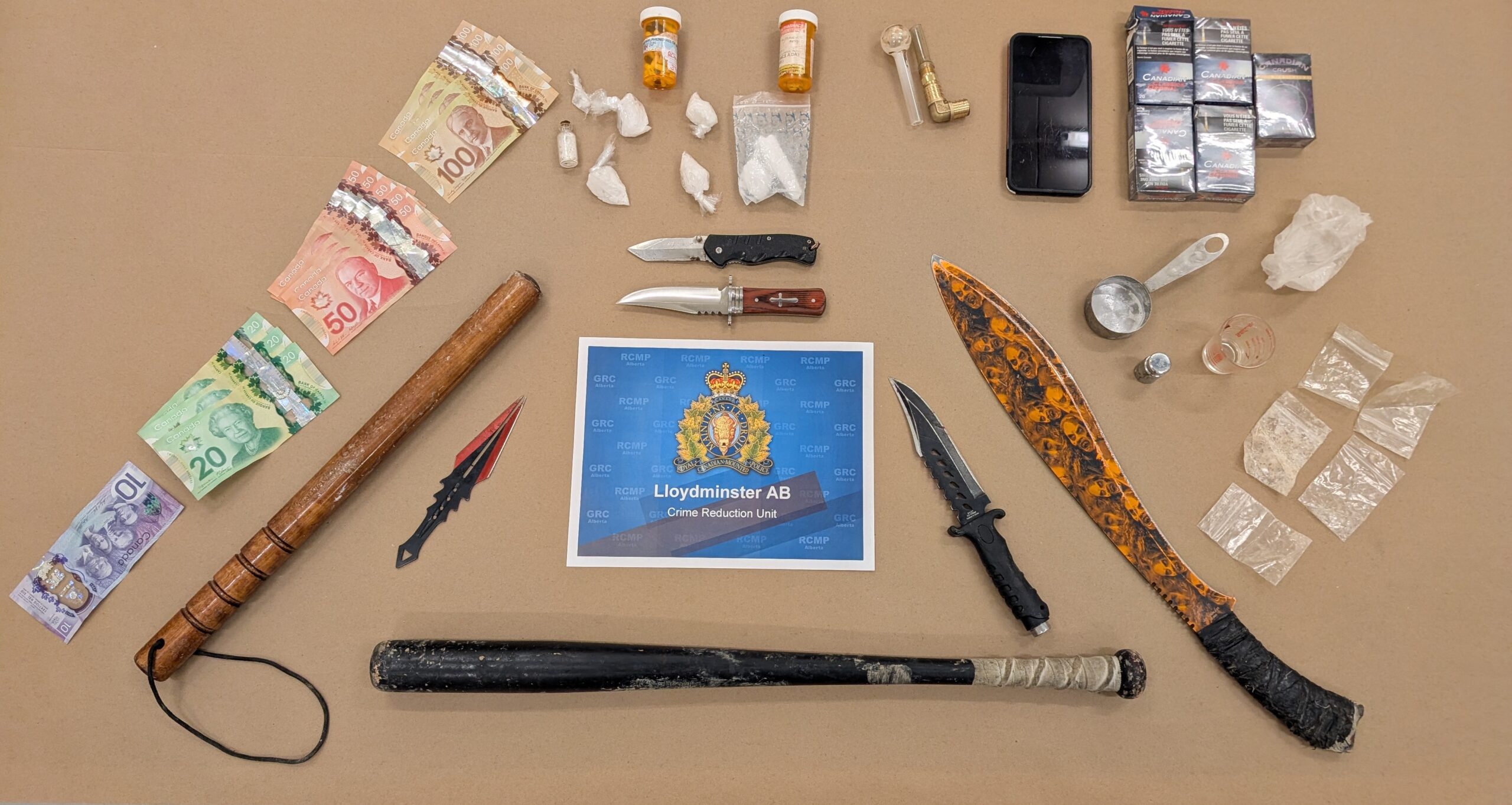
The city’s General Investigative Section says some drug dealers are back in business within a week of arrest. Narcan is keeping people alive. And the courts are not helping.
Staff Sgt. Jerry Nutbrown didn’t sugarcoat it.
Lloydminster’s drug problem is persistent, evolving, and outpacing the tools available to the officers trying to address it. Nutbrown, who leads the RCMP‘s General Investigative Section at the Lloydminster detachment, delivered a candid street-level briefing to the city’s Governance and Priorities Committee Monday that left little doubt about the scale of the challenge.




“We’ve had some back in business in less than a week,” Nutbrown said of dealers his unit has arrested and charged. “It’s kind of like the old bailing out your ship in the middle of the ocean. And you’ve got a bucket, but your hole in your ship’s about five feet wide.”
Identifying Drugs by colour: Fentanyl
Fentanyl remains the dominant drug driving overdoses in the city. Nutbrown told council his unit tracks incoming batches by colour – a detail that sounds unusual but serves a critical operational purpose.
“That will help us to be able to identify what’s being sold right now,” he said. “And if we’ve got ODs, then what colour are we looking at?”
Different drug colours indicate different batches, with varying potency and composition. Users often carry multiple colours at once. When overdoses spike, knowing which batch is circulating helps officers and paramedics respond more effectively.
RCMP members are carrying Narcan, typically reserved for officers who experience accidental drug exposure, and using it almost entirely on members of the public.

“We use almost all of it on others because we’re finding them,” Nutbrown said. “And it has saved many, many lives in the city here.”
Drug overdoses happen for two main reasons, he explained. Users returning to a drug after a period of abstinence often misjudge their tolerance. Others are caught off guard by what’s mixed into a batch they thought they knew.
The prosecution gap
One of the most significant frustrations Nutbrown shared involves the courts. Simple possession charges, he said, go nowhere.
“There’s no appetite for possession charges unless it’s linked to something else,” he said. “The charges would just be withdrawn or removed and it wouldn’t carry through to a court. So that’s one of the challenges we’re still seeing.”
The unit is focusing enforcement on dealers rather than users – but even that has limits given how quickly the supply chain refills.
Coun. David Lopez said the reality lands differently when you’re a business owner dealing with it directly.
“I had two different locations, two different people and both using, and it’s just, it’s hard for my staff,” Lopez said. “We’re cleaning up the paraphernalia.”
Lopez called on residents to contact their MLAs and MPs if they want the laws changed, noting the frustration is shared across the table.
“It’s got to be frustrating for your team to arrest the same guy every week,” Lopez said.
“There’s much frustration in our unit and within the detachment,” Nutbrown replied. “But we just keep trying to push forward and do what we can do.”
Who’s actually downtown
Nutbrown pushed back gently on the assumption that everyone visible in the downtown core is homeless. The reality, he said, is more complicated.
Some people have housing in the city but are drawn downtown by addiction or the social environment. Others are passing through – sometimes for days, sometimes longer. Transients from other cities are not uncommon. He described speaking with two people from Winnipeg last week who were in Lloydminster as a stopover, and ended up being dealt with because of addiction-related behaviour.
“Where are you from? What brings you to town? Those are like two of the key questions I always ask,” he said.
Nutbrown noted his unit has seen a modest decrease in street-level activity this spring compared to the same period last year – though he cautioned that trend is weather-dependent and can shift quickly.
Retail theft and the Agent Program
The unit has been running targeted retail theft operations, embedding with loss prevention officers at high-victimization stores and making direct enforcement calls – no warnings.
“It’s not a, we’re going to give you a warning kind of thing,” Nutbrown said. “Usually it is a trespass notice. You’re no longer allowed back in this retail outlet. As well as the charges that are applicable.”
The Agent Program, which allows RCMP to act on behalf of registered businesses on trespass and nuisance issues after hours without needing the owner present, now has approximately 100 enrollments. City administration confirmed 89 businesses have signed up through the municipal side of the program.
Nutbrown encouraged more businesses to register, noting some told him they hadn’t signed up because they didn’t feel they needed it – a position he said misses the point of after-hours coverage.
Community tips working
Nutbrown closed with a direct ask to residents: report what you see.
“We had some that were not on our radar at all,” he said. “We found that, we did a little bit of what we do and we ended up with charges on some of that strictly because of the people that are watching going, that doesn’t seem right. And that’s all we need.”
Coun. Michele Charles Gustafson echoed the call.
“Don’t think you can’t be part of the solution,” she said. “There’s a call to the community to report what you see if something doesn’t smell right.”
Tips can be submitted to the RCMP non-emergency line or anonymously through Crime Stoppers at 1-800-222-8477.
Read more: RCMP say crime numbers tied to reporting as council reviews data




The RCMP uniform members are doing a great job in Lloydminster – hopefully they will get more resources to help with their huge demands. Hopefully with the street level drugs and the massive retail theft problem they can work their way up the chain, viz., catch the drug suppliers and track who, or what businesses, are buying the stolen goods. They did it in Ontario in 2026 and cancelled the business licenses of business that were buying the stolen merchandise. These higher level targets are not the focus of the overworked uniformed members they don’t have the time or resources but this needs the support of senior management who can approve operational plans to make a real difference.