




More than 1,400 residents gave feedback on the proposed traffic bylaw changes this year. As a result, administration still proposes changing some speed limits across Lloydminster, but not all.
Andrew DeGruchy, the city’s director of public safety, presented the survey results to the Governance and Priorities Committee on Monday.
Most respondents disagreed with the proposed speed zone changes, DeGruchy said. About 64 per cent opposed them and 30 per cent supported them.







The city also tracked real driver behaviour. Radar counters monitored about 113,000 vehicles in 12 to 14 residential areas.
DeGruchy said 85 per cent of drivers travelled at or under 48 km/h. Only about two per cent went faster than 56 km/h.
“From a speeding perspective, we do not have concerns about speeding within the community,” said DeGruchy.
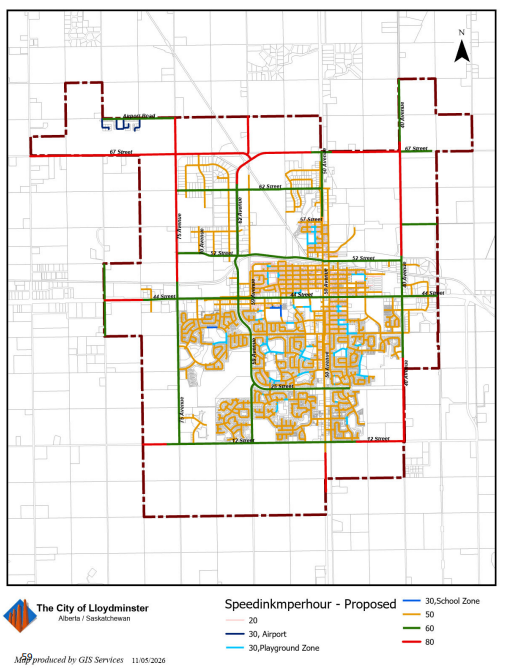
Based on that data, administration recommends keeping the default speed limit at 50 km/h. School and playground zones would stay at 30 km/h.
Several councillors still want it lower. Mayor Gerald Aalbers said he would like to see 40 km/h in residential areas.
He said a pedestrian hit at 40 km/h has a much better chance of surviving than one hit at 50. He expects an RCMP report on that point.
If council does not approve 40 this year, Aalbers asked administration to survey residents again in a year. He wants them asked whether they would like a slower speed in front of their own homes.
Coun. David Lopez agreed.
“I think we’re doing ourselves a disservice if we don’t put that speed limit to 40,” said Lopez.
Coun. Jim Taylor argued that drivers push past whatever limit is posted. He said a higher default only widens the gap.
“If you leave it at 50, we’re pushing it to 55, 60,” said Taylor.
Coun. Michele Charles Gustafson pointed to a gap between the numbers and what residents say. Only two per cent of vehicles were speeding, she noted, yet people still tell the city traffic is too fast.
She said a simple agree-or-disagree survey cannot capture that. Asking residents how they want their own street to feel, with kids playing outside, could produce a different answer.
The sharpest debate came over 44 Street, part of Highway 16. Administration proposed a consistent 60 km/h along its full length so traffic does not keep slowing and speeding up.
DeGruchy said city engineers and operations staff believe the four-lane road can handle it. The change would add 10 km/h in some stretches.
Coun. Jason Whiting said he opposes the increase. He said semi trucks already run yellow and red lights at those intersections.
Whiting said drivers rarely get ticketed at 65 or 66 km/h, so a 60 limit would likely mean speeds of 65 to 70. He added that the road has heavy cross traffic and pedestrians.
He said signal timing would also need to be longer to give heavy trucks room to stop. The more he thought about it, the firmer his opposition became.
Gustafson sided with Whiting. She said a 60 limit makes sense if the goal is moving traffic, but residents consistently say safety is their main concern.
Her priority on Highway 16 is safety over flow, she said. A driver’s ability to stop matters more than the posted limit, and 44 Street has many reasons to stop suddenly, including pedestrians and cyclists.
Aalbers said he has watched near misses when trucks enter intersections on yellow or red lights. He said a loaded truck can weigh about 130,000 pounds, and he did not support raising the limit.
Taylor made a similar argument. He said a 60 km/h limit would push drivers to 65 or 70.
Administration also proposed removing College Drive as a truck route. Whiting and Coun. Justin Vance worried that would send grain trucks to the busy intersection at 75 Avenue and 12 Street.
Aalbers said he would hold off for one year, until the 52 Street extension is finished.
Administration will monitor 75 Avenue and 12 Street for about a month and a half before the bylaw returns for first reading. It will also bring back alternative speed options.
Read More: New information ahead of feedback form for traffic bylaw