




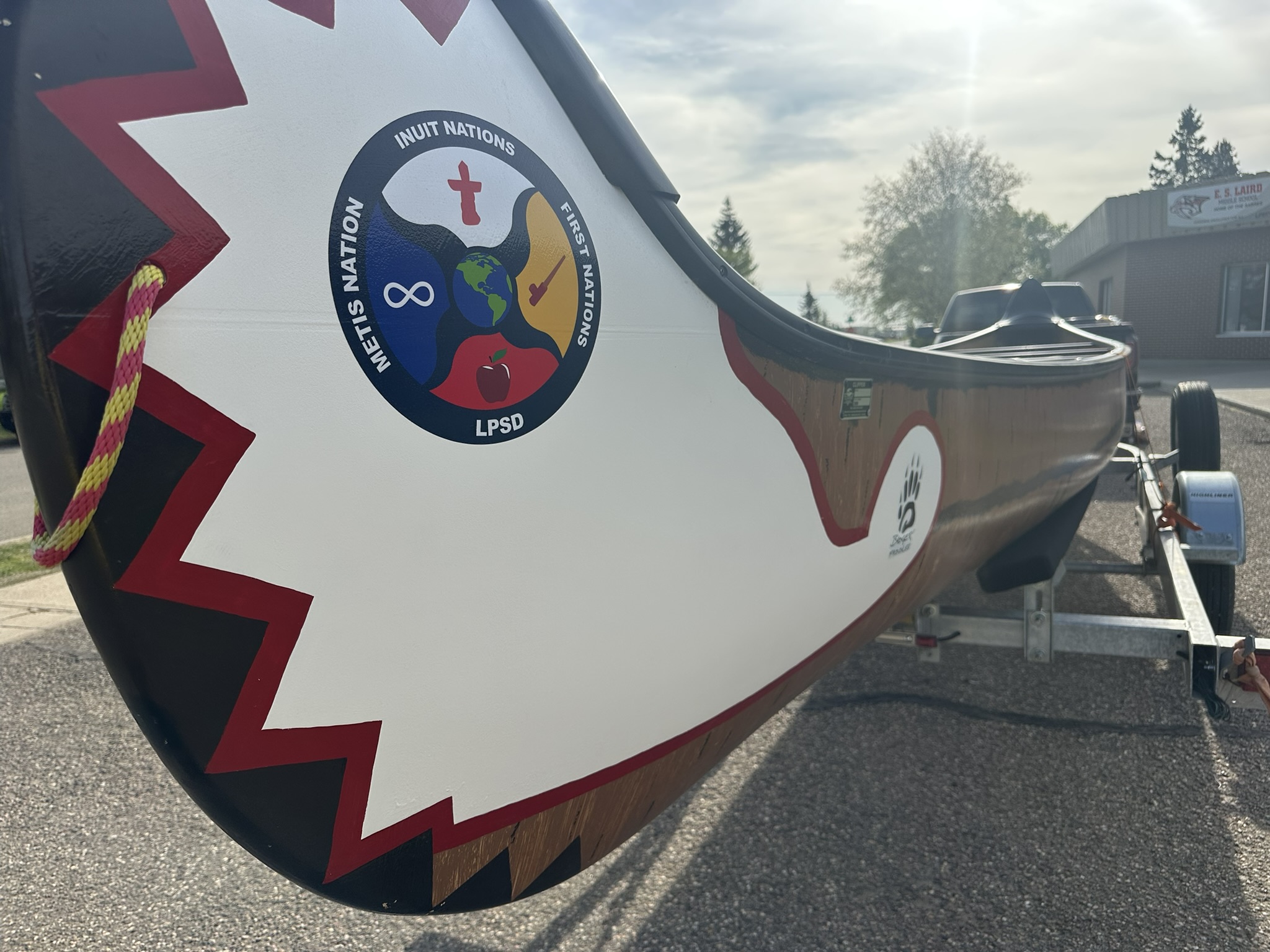
The canoes pushed off from Fort Pitt on May 28. Eight days and 348 kilometres later, they arrived at Fort Carlton.
Students and staff from five Lloydminster Public School Division schools completed the Treaty 6 150th Commemorative Canoe Voyage between May 28 and June 4, paddling the same stretch of the North Saskatchewan River connected to the negotiation and signing of Treaty 6 in 1876.
The voyage marked the 150th anniversary of the treaty and was designed as a land-based learning experience built around history, reflection, and teamwork.




Lloydminster Comprehensive High School and Avery Outreach School launched the first leg from Fort Pitt, paddling 114 kilometres through wind, heat, and rain before handing off at Paynton Ferry. E.S. Laird Middle School took over from there, covering more than 140 kilometres through North Battleford and past Fort Battleford National Historic Site, camping at the Caplette Islands before pushing on to Glenburn Regional Park. Bishop Lloyd Middle School and College Park School completed the final stretch, paddling from Glenburn through Borden Bridge and Petrofka before arriving at Fort Carlton.
Each crew change was both a handoff and a shared moment, students carrying the same journey forward in relay.
Libby Sherbinin, a Grade 12 student at LCHS who paddled the first leg of the voyage, said the experience gave her more than she expected.
“I had a really great time. I learned a lot about myself and about Treaty 6, I think it was a really, really great experience overall,” Sherbinin said.
The weather tested the early crew. Sherbinin said one day brought intense heat along with extra kilometres on the water.
“It was super hot one day, so that was kind of a challenge. We had some extra kilometres to put on that day too, that was definitely the most challenging day.”
For Sylas Moore, a Grade 8 student at College Park School who paddled the final leg, the physical demand was the hardest part.
“Probably the paddling, the endurance. Paddling 50K for two days, and then even on the last day we only paddled 25 but we had to get there at a certain time so we still had to paddle hard,” Moore said.
The downtime between paddling stretches offered its own lessons. Moore said the crew fished, told stories around the fire, and played card games at camp.
He also came away with a clearer picture of what the river meant to Indigenous peoples long before any school trip.
“Back in the day they paddled that and it was the only way they could get their stuff for the trades and the treaty, and it would have been even harder for them because they had to paddle upstream,” Moore said.
Asked what he thinks he will remember a decade from now, Moore did not hesitate.
“Probably just the experience, and that I got chosen to do that. That’s a very special thing for me.”
The voyage drew attention beyond Lloydminster. CBC Radio featured the trip in a special soundscape segment during the journey, capturing the sounds of river life from the water.
The project was brought to life in large part through the vision of E.S. Laird principal Luke Maw, who joined his school’s crew on the water.
Students and staff who participated came from Lloydminster Comprehensive High School, Avery Outreach School, E.S. Laird Middle School, Bishop Lloyd Middle School, and College Park School.
Read more: Cenovus backing fuels LPSD robotics program’s growth










My heart still pounds, loud and proud, like the drums of my culture. I am so proud of this ambitious endeavour and historical achievement of these young people – and kudos to all adults, community and supporters involved! We have been so honored to be included in this trek and it will be dearly remembered for a long time. ❤️