



This is the weekly opinion column by owner/founder of Border Pulse.
This is the third time. The third community where I have asked questions that powerful people would rather not answer. The third city hall that has bristled at coverage it didn’t control.
The third place where the reflex has been the same: don’t fix the problem, discredit the person pointing at it.
I have been doing this for nearly 15 years. I have sat across from mayors, city managers, and administrators in communities across this country, and I have learned one consistent truth: the louder the pushback, the closer you are to something real.




In Sault Ste. Marie, city hall and a mayor once demanded we come to them to answer for our coverage. We told them if they had a problem with our work, they were welcome to come to us.
They sent communications staff and a manager. The mayor, conveniently, had to cancel.
Internal memos circulated about the organization I worked for. The goal was never dialogue. The goal was pressure.
That’s not unique to any one city. It is a pattern as old as public office itself.
Connections that make things run more efficiently, in the sense that efficiency means fewer people asking inconvenient questions. Decisions made in rooms where the public technically had the right to be, but practically had no idea anything was happening.
Which brings me to Lloydminster. And to the last GPC meeting.
I filed a delegation request to speak before council. I wanted to speak to them about whether residents are being properly informed and given meaningful opportunity to participate in their own governance.
I wanted to share my concerns. As a citizen, a business owner, and a journalist, based on what I’ve discovered during my time invested into this. I was denied that opportunity.
Because here is what I have learned about how this works.
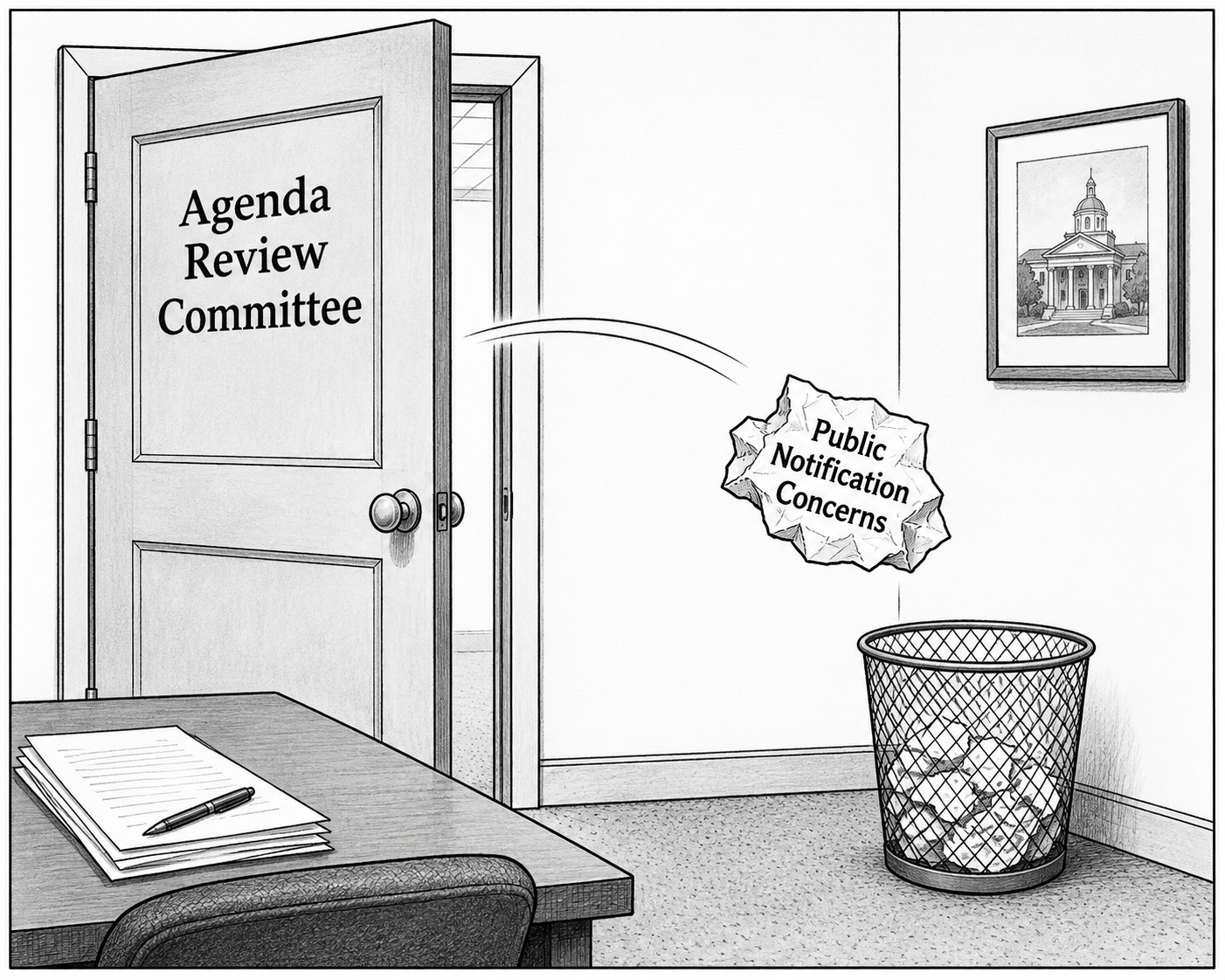
The Lloydminster Charter requires anyone wishing to address council to notify the City Clerk seven days in advance. The poster the City promotes, the one that says come talk to your council, advertises four days.
Residents report that discrepancy has been used to turn people away.
The agenda for a Monday council meeting is posted the Friday before. That is zero business days.
You cannot register to speak about something you did not know was on the agenda until it was already too late to register.
The window is not just narrow. It is, by design or by negligence, effectively closed.
And then there is the matter of the public hearing for Bylaw 04-2026, a land use amendment affecting this community, held May 25.
Advertised, as far as any legal standard is concerned, in a publication that no longer prints and distributes to the doorsteps and mailboxes of this city.
Not a single member of the public showed up. The bylaw passed.
I have been told that my coverage of this issue has made people uncomfortable. Good. It should.
The people paying taxes in this city fund every salary in that building, every public notice, every process that is supposed to exist so that they know what their government is doing in their name.
When those processes fail, quietly and without fanfare, the people most affected are not journalists. They are residents who trusted that the system was working because no one told them otherwise.
The questions I am asking are not my questions. They belong to the people who could not register in time, who did not know about the hearing, who found out after the fact that a decision had already been made.
I am not responsible for making accountability comfortable.
Substantially all residents is not a slogan. It is a legal standard. Right now, it is being treated like a suggestion.
Read more: Opinion – Substantially All Residents