




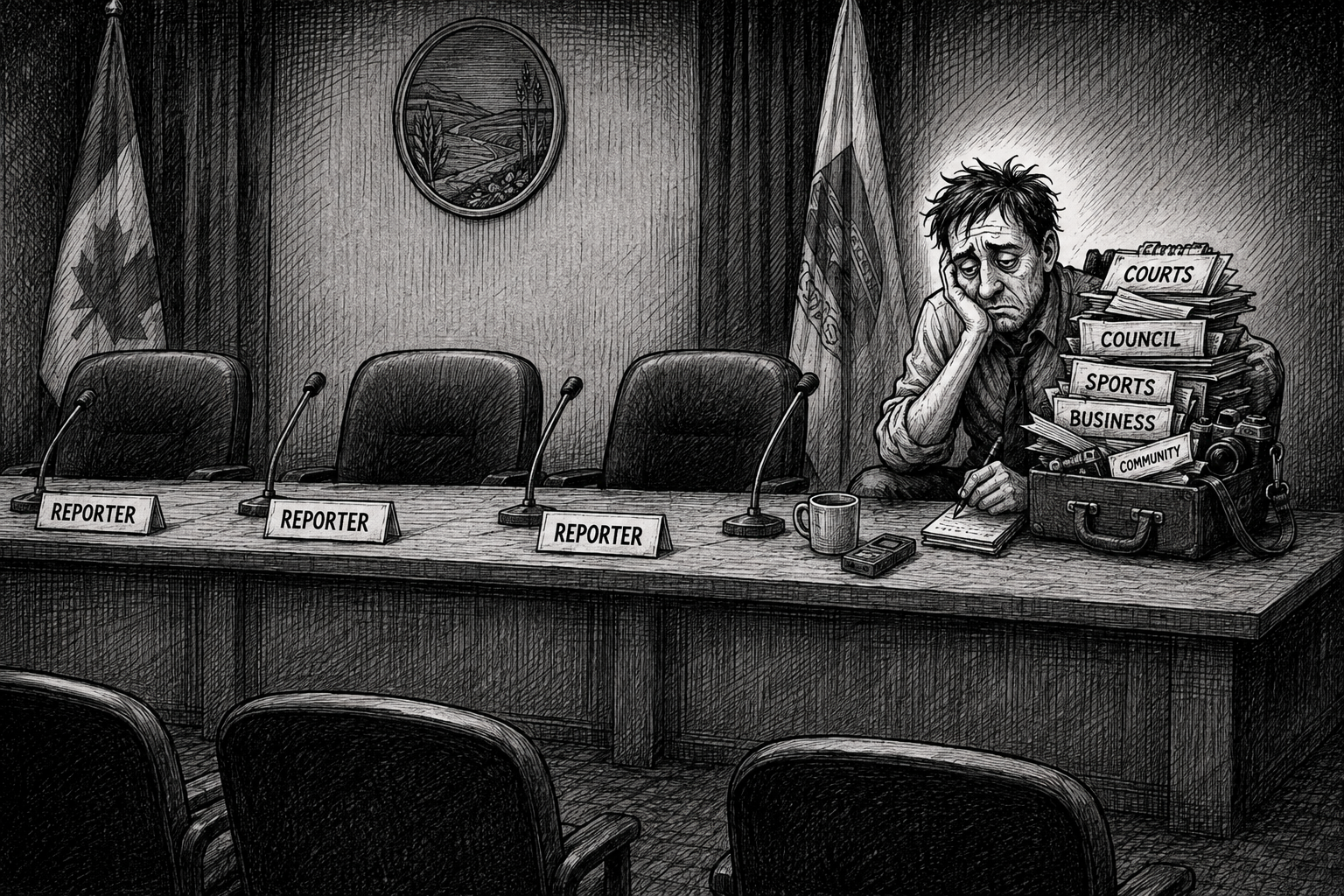
Lone Reporter sits at a city council meeting in this Editorial Cartoon created for Border Pulse.
Lloydminster has lost its TV stations and watched its longest-running newspaper thin out. Editor Dan Gray’s column on what that costs a community.
Lloydminster‘s media market looks different than it did two years ago, and it’s worth taking stock of that.






In May 2025, Stingray Group abruptly shut down our beloved TV station, PTLN. The move ended more than 60 years of local broadcasting and put 19 employees out of work with no advance notice.
The stations had covered this community since 1960 and 1976 respectively. Stingray cited declining revenue, audience fragmentation and advertiser migration to digital platforms. Even the Meridian Source’s own staff wrote at the time about how fragile this industry has become.
I know that newsroom’s work firsthand. In a column I wrote there in December 2024, I credited my then editor Taylor Weaver for breaking a difficult story. She did not back down under pressure to bury it. That kind of reporting is exactly what a community loses when a newsroom shrinks to one person.
More recently, the Meridian Source has scaled back significantly. Its Aug. 6 edition ran 32 pages with a full sports section and a masthead of four staff. The following week’s edition ran 14 pages, carried no sports section, and listed a single staff member on its masthead.
I’m not writing this to take shots at a competitor. I spent 15 months at the Meridian Source before launching BorderPulse. I have real respect for the work that goes into putting out a weekly paper in a market this size. It’s hard, often underpaid work, and I know that from the inside.
What thinner newsrooms lose
This market has lost its television stations. In that same window, its longest-running newspaper has shrunk too. That is bigger than any one outlet’s business story. It’s a story about how much independent coverage this community has left, and who’s actually left to do it.
Thinner newsrooms don’t just mean less coverage. They mean less capacity to hold ground when someone doesn’t want a story told. Those are often the exact stories worth the fight.
A newsroom with one person covering everything doesn’t have time to wait out a source who’s stalling. It doesn’t have time to push back when an institution hires a third party to keep an investigation out of the public record. When a community loses that capacity, it doesn’t just lose bylines. It loses accountability.
New voices keep showing up
The picture isn’t entirely bleak. The Weekly Bean has grown over that same stretch. A handful of independent, community-run social platforms have stepped in to fill pieces of the gap too. Each covers this community through its own lens.
Local journalism has never been a growth industry, and small markets like ours have felt that squeeze harder than most. But new and independent voices keep showing up, even as legacy outlets fold or shrink. That says something about how much this community still wants to be covered.
BorderPulse exists because we believe this market can support real accountability journalism. We’re going to keep showing up, at council, at the courthouse, and everywhere else the story is. Whatever happens with the rest of the local media landscape, that’s not going to change.
Read more: Column: Do you have solutions?















Right on. And good luck. Im in a different kind of industry, and see same effect of “closures, trimming, etc.( what ever they call it)”. Big companies buy out everything for “market share” or “whatever”. Most of the time local areas suffer. As we/you’ve seen. Some people like yourself recognize the opportunity to fill the empty spots and capitalize on it, as you and I have done.
Good for you and good luck. You’ll be fine I’m sure.
On a side note, there are alot of people that still like to get “local news, events” via newspapers, radios, and them electronic billboards.
I agree, we have a small print paper as well, it’s meant for the seniors homes etc.