




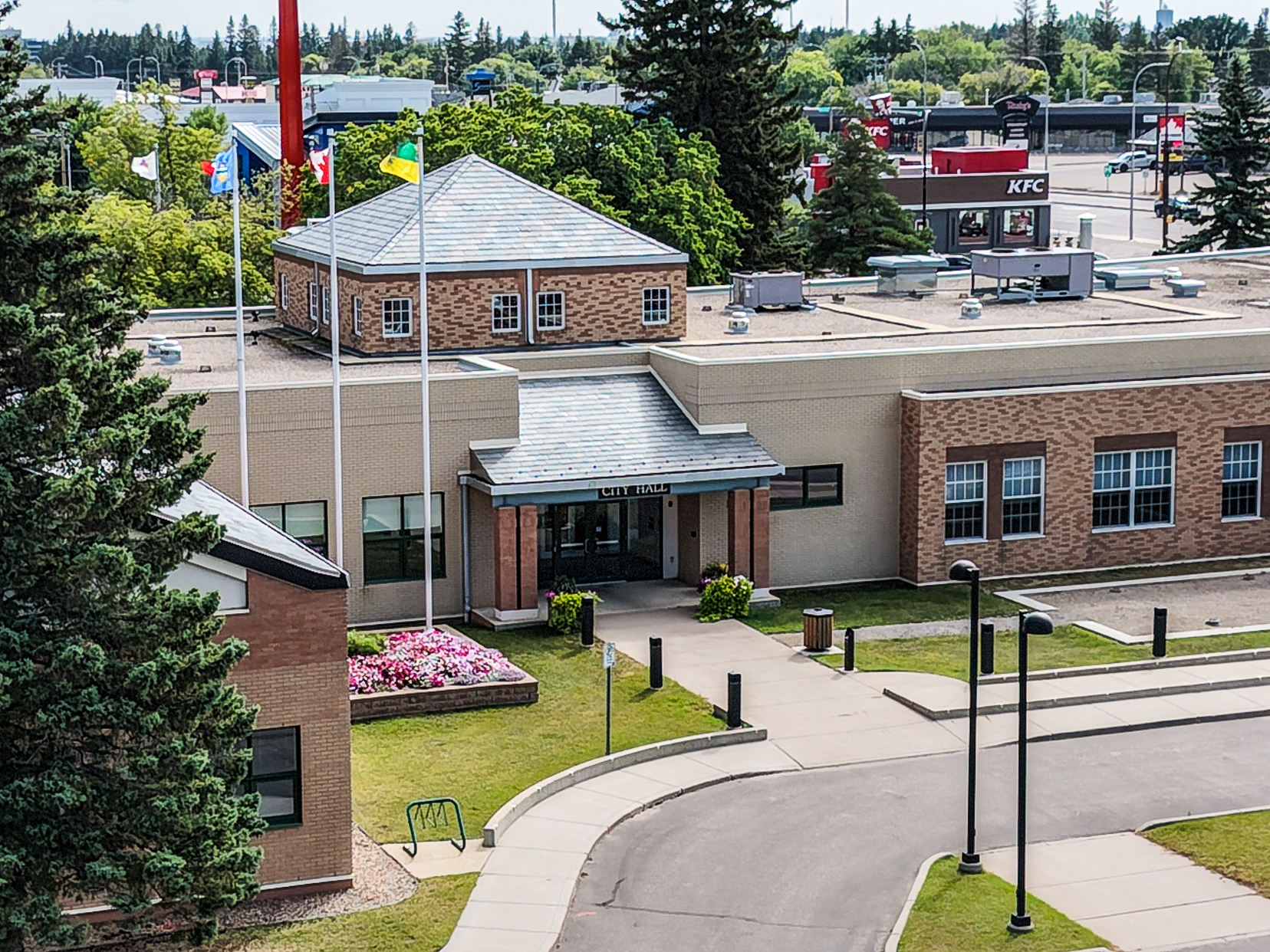
Lloydminster City Hall during summer of 2026. Dan Gray - The Border Pulse
Lloydminster’s municipal enforcement team is writing more tickets and freeing up RCMP resources one year into a major restructuring, but the change has come with a steep drop in revenue, according to a review reports provided to council recently.
Andrew DeGruchy, the city’s director of public safety, told the Governance and Priorities Committee the shift followed the province’s decision to sharply restrict automated traffic enforcement.







“In July of 2025, we received approval from city leadership to restructure the automated traffic enforcement into bylaw enforcement officers. This did result in a slight downsizing of our teams,” said DeGruchy.
The province cut the city’s approved photo radar sites from 66 to six, permitting the technology only in school, playground and construction zones. In response, the city replaced its photo radar operators with two bylaw enforcement officers, tasked with traffic bylaw enforcement, unsightly premises complaints and community standards.
Financially, the picture has shifted sharply. In 2024, the city’s photo radar program cost about $180,000 to run and brought in roughly $170,000 in revenue, DeGruchy said. For 2026, the city is forecasting about $228,000 in bylaw program expenditures against just $37,000 in revenue.
Coun. David Lopez asked administration to clarify what that revenue figure actually represented.
“So we’re doing about $200,000 in revenue. Is that what you’d say?” said Lopez.
DeGruchy said the $37,000 reflects only bylaw enforcement officer tickets, while the city’s community peace officers, a separate tier of enforcement, are bringing in roughly another $180,000 to $200,000 through provincial ticketing.
Some of that shortfall traces to circumstances outside the city’s control. A months-long Canada Post strike in late 2025 froze the city’s ability to mail out tickets, and DeGruchy said holding onto them for a later mailing risked the tickets being thrown out in court.
“We had a choice in municipality. We could retain some of those tickets… with an understanding that a parking ticket that we’re having to hold onto throughout the full duration of a strike, to then mail out, would not survive the court. So we lost a lot of that revenue throughout the year,” said DeGruchy.
On the enforcement side, the numbers point the other way. Bylaw and provincial tickets have nearly doubled since the restructuring, and RCMP call volumes tied to traffic and bylaw matters have declined over the same period, though DeGruchy noted broader RCMP restructuring and falling crime trends are also contributing factors.
The change hasn’t been without friction. Coun. Michele Charles Gustafson asked what feedback the city had received since the restructuring took effect.
“We heard lots of complaints about the parking downtown,” said Charles Gustafson.
DeGruchy said the enforcement of downtown parking rules, aimed at stopping employees from occupying customer stalls, drew immediate backlash.
“I think I should change the wording there, because I didn’t get a lot of great feedback on the parking tickets,” said DeGruchy. “The first round of enforcement we did on that, we were inundated with complaints from staff members who had traditionally parked there, who are needing to see other parking opportunities within the downtown core.”
Coun. Jim Taylor pressed for more transparency on how the team’s time is actually spent, particularly time-intensive unsightly premises files that don’t generate revenue but still consume enforcement hours.
“It just would be interesting, maybe in a Friday report at some time, just a call volume list when it comes to something like unsightly properties and how much time does that actually take,” said Taylor. “So, you know, because if somebody looks at the numbers, ‘oh, they’re not making any money, what’s the point?’ And that’s not the way I’m going with it. It’s what else are they doing that is making an impact in the city.”
DeGruchy said each officer costs the city significantly less than an RCMP member.
“An RCMP officer is 500,000 a year,” said Lopez.
“It costs us about $240,000 a year, a community peace officer, one 50, one 60, and a bylaw enforcement officer around 120 of an all-in cost, vehicle kits, salaries, everything,” said DeGruchy.
Coun. Justin Vance asked whether the city’s two bylaw enforcement officers are fully cross-trained across all city bylaws. DeGruchy said officers began in a single discipline, either traffic or community standards, and are gradually being cross-trained in others, including animal control and land use bylaws, as they gain experience.
The city’s public safety budget, which includes RCMP, community peace officers and bylaw enforcement combined, is forecast to reach $14 million by 2027, with municipal enforcement’s share of that budget rising slightly, from eight per cent in 2024 to a projected nine per cent in 2027.
No motion was required on the report. Council received it as information.
Read more: Taxi and Vehicle for Hire Bylaw

















We are back to normal. Public safety is a center of cost. Not to be seen as a source of revenue.
When an officer or a municipality looks at what laws to enforce, revenue potential should never be a priority.
We want a liveable city with cleanliness and safety as a priority.
Doing 15 over on hwy 16 or on the multiplex road is not a hazard. evem if it was, putting a ticket trap does nothing to improve safety it is just a tax. Probably does worse for public safety, as people have apps that mark ticket traps. so they slam on the brakes right before the trap, its more of a hazard than vehicles moving freely at a slightly higher speed than planned. We are all on the road following each other doing 65 instead of 50, where is the problem. As a society we made our own rule and it makes more sense than what some clown in an office decided.
they want to lower speed limits to increase revenue and keep travelers longer in the city so they have a longer exposure to business frontage and our border markers maybe. What an assinine way to view what we have to offer. “we need a captive audience to sell our city”
Traffic needs to flow.
Administrators and council needs to get out of the way.