




Lloydminster Hospital delivers roughly 800 babies a year. A $262,260 health assessment says some of those newborns are being transferred out of the city for reasons that have nothing to do with their medical condition.
Every year, approximately 800 babies are born at Lloydminster Hospital.
Some of them are transferred to Saskatoon or Edmonton shortly after.




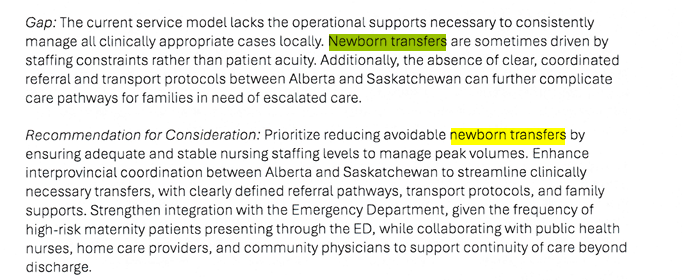
According to the Lloydminster Health Service Needs Assessment, those transfers are not always driven by the medical needs of the newborn. “Newborn transfers are sometimes driven by staffing constraints rather than patient acuity,” the assessment states.
Patient acuity means how sick a patient is. The assessment is saying some babies are leaving Lloydminster not because they need a higher level of care, but because the hospital does not have enough staff to keep them.
The assessment uses a specific word for this. It recommends Lloydminster Hospital “prioritize reducing avoidable newborn transfers.”
Avoidable.
That word belongs to the government’s own consultants. It appears in a document two governments received in December 2025, withheld from public access in June 2026, and summarized in four pages that did not explain what was driving the transfers.
What the hospital has vs. what it doesn’t
According to the report, Lloydminster Hospital’s maternity unit is described in the assessment as well-established. The facility supports approximately 800 births annually. It has 13 inpatient maternity beds, three delivery rooms, and five practicing obstetricians. Nursing staff are trained to provide advanced maternal and newborn care during the immediate postpartum period.
What it does not have is a Newborn Intensive Care Unit.
“The site does not operate a designated Newborn Intensive Care Unit (NICU) or Special Care Nursery, and newborns requiring specialized or advanced care are transferred to tertiary facilities,” the assessment states.
That is expected for a hospital of Lloydminster’s size and designation. What is not expected is transfers happening because of staffing gaps rather than clinical need.
The gap the assessment identified
The assessment is direct about the problem.
“The current service model lacks the operational supports necessary to consistently manage all clinically appropriate cases locally,” it states.
In plain terms: the hospital should be able to handle these cases. It is not always doing so, and the reason is not the babies’ condition.
The assessment also identifies a second problem compounding the first. “The absence of clear, coordinated referral and transport protocols between Alberta and Saskatchewan can further complicate care pathways for families in need of escalated care,” it states.
A family whose newborn needs to be transferred faces not only that medical reality, but a jurisdictional maze. Which province authorizes the transfer? Which province pays? Where does the baby go? The assessment identifies these as unresolved questions.
“Particularly in the context of inter-facility transfers, planning and operations are complicated by cross-jurisdictional governance, which requires alignment between provincial health authorities in Alberta and Saskatchewan,” the document states.
What the assessment recommends
The assessment’s recommendation is specific.
Lloydminster Hospital should “prioritize reducing avoidable newborn transfers by ensuring adequate and stable nursing staffing levels to manage peak volumes.” It should “enhance interprovincial coordination between Alberta and Saskatchewan to streamline clinically necessary transfers, with clearly defined referral pathways, transport protocols, and family supports.”
The assessment also calls for strengthened integration with the emergency department, given “the frequency of high-risk maternity patients presenting through the ED.”
These are not complicated asks. The assessment itself describes them as enhancements to existing approved maternity services, not a new program or a new facility. The hospital already has the scope to care for these babies. The assessment says it needs the staffing and the protocols to do it consistently.
What transfer means for a family
The assessment acknowledges what a transfer means in human terms.
“These transfers often impose significant stress on families and disrupt continuity of care,” it states.
A parent delivering in Lloydminster does not expect to watch their newborn leave for Saskatoon or Edmonton. When that happens because a nurse was not available rather than because the baby required a higher level of care, it is not a clinical outcome. It is a system failure.
This is not the first time the problem has been identified.
This is not the first time the problem has been identified. A 2013 health assessment commissioned by the same two governments listed Women and Children’s Health as a priority service area and recommended a recruitment and retention strategy for obstetrics, gynecology, and pediatrics at Lloydminster Hospital. Twelve years later, the 2025 assessment found newborns are still being transferred out, sometimes not because they need higher-level care, but because the staff are not there to keep them.
The assessment says it is addressable. Two governments have known that since December 2025.
Tomorrow: Fixing our mental health crisis
This is the next part in a multi-part investigative series revealing what they don’t want us to know about the Lloydminster Health Needs Assessment.
Read the full series so far: Lloydminster Health Needs Assessment: Investigation