



Vic Juba grew up in a place most people have never heard of, on land his grandparents broke by hand.
Lavoy, Alberta. A small dot northeast of Vegreville, the kind of town you could miss entirely if you sneezed at the wrong moment on the highway. His grandparents homesteaded sixteen miles northeast of there – a ten-dollar homestead, the kind that required more stubbornness than money.
There were six children at the Juba table. Eight people every night, his parents included. The farm ran on the kind of economy that had no name for itself – neighbors showing up when a neighbor needed help, farmers pulling together because that was simply what you did. Nobody called it volunteering. It was just life.







“When I was growing up, the word volunteer was – I never heard it,” Juba said. “To us, it was just a neighbor helping a neighbor.”
He went to a one-room schoolhouse in the country. By the time he reached grade nine, he was attending in Lavoy. Grade ten brought a new problem – there was no teacher available, so he went to Strathcona, in Edmonton, to finish the year. He came back.
The war years touched everything, including how and where a young man from rural Alberta could get an education. Juba eventually made his way to the University of Alberta, where he completed four years in chemistry. He was still young, still figuring out what came next, when a blind advertisement in a chemistry journal changed his direction entirely.
Just a box number. No name. No location.
He answered it.
A Cold Day and a Job Offer
It turned out to be Husky Oil Company in Lloydminster – a city he had never heard of and never visited.
They invited him for an interview. He arrived on a bitterly cold January day in 1953. No wind, but the roads were pure ice. Two men met him for lunch at the Royal Café, a building long since demolished, and offered him a job before the meal was done.
He was twenty-two years old.
“I thought, I’ll come here for a couple of years and then I’m out of this place,” Juba said.
He never left.
“Husky was good to me,” he said. “And I ended up progressing fairly quickly. The community was very good.”
The city he arrived in was a fraction of what it is today – roughly 4,800 people, a handful of businesses clustered north of Highway 16, and an invisible line down the middle that divided Alberta from Saskatchewan. That line, and everything complicated about it, would become a recurring theme of his life here.
In those early months, Juba noticed something. The only people he knew were the men he worked with at the refinery. He was meeting no one else, seeing nothing beyond the fence line.
A colleague named Murray Moore invited him to a Lions Club meeting.
He went.
“People – a diverse group of people,” Juba recalled. “The work they were doing at that time, they were talking about a playground. And I was impressed.”
He joined in January of 1954. He is still a member.
That meeting reframed something he had carried since childhood without ever naming it. The instinct to show up for the people around him – learned on a homestead where helping your neighbor was simply expected – suddenly had a structure, a community, and a purpose larger than the farm.
“I think quite a bit of it is patriotism, if I could use that word,” he said, reflecting on what drives volunteerism in Lloydminster. “I think we love this city, and we’d like to see it grow.”
The Man They Called When Something Needed Doing
Over the years that followed, Vic Juba’s name became attached to nearly every significant project Lloydminster undertook.
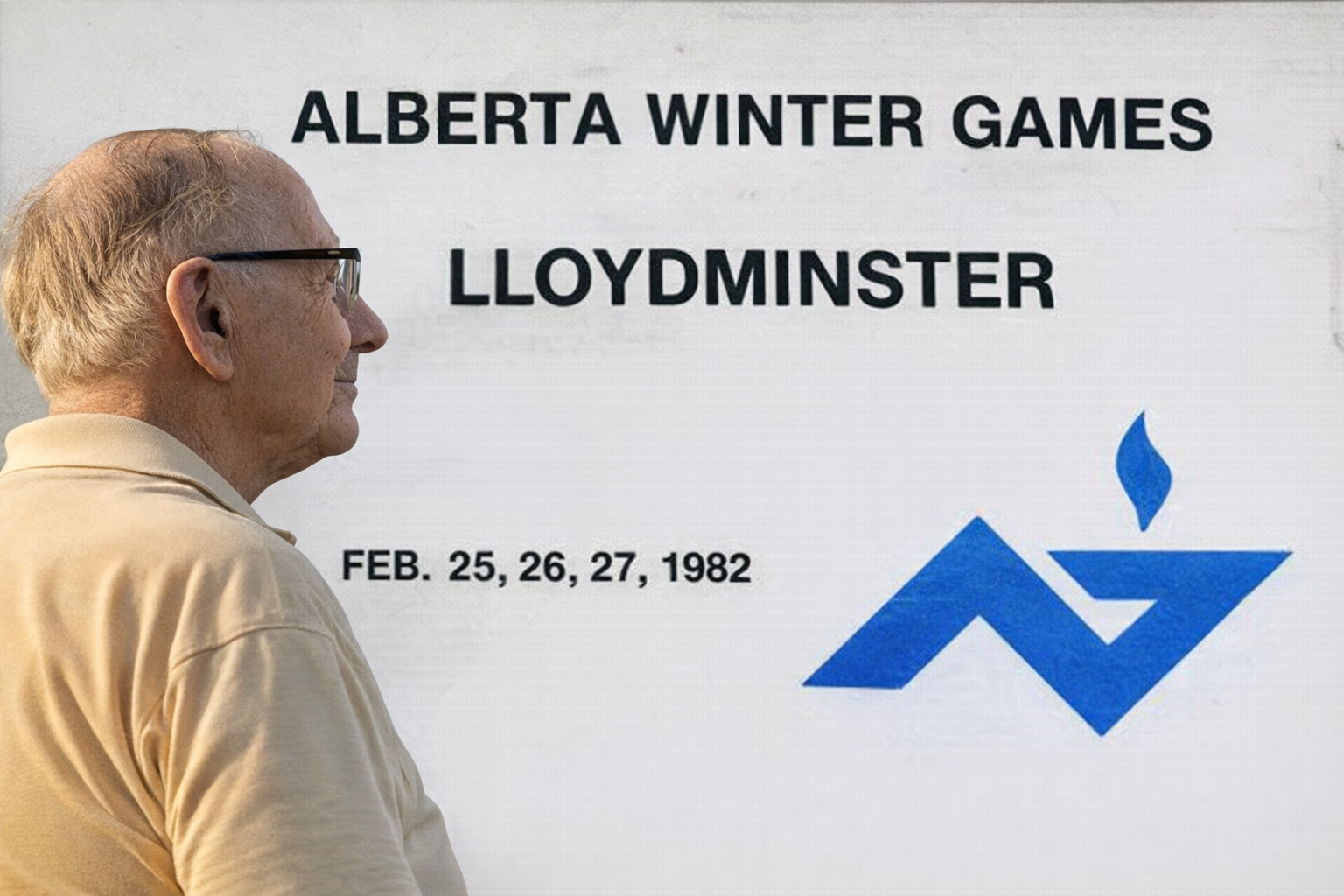
The 1982 Alberta Winter Games – the largest event the city had ever hosted, with a budget of $436,000 and thousands of volunteers mobilized across the region. His work with the Alberta Sport Council would eventually see him chair not only the Winter Games but the Summer Games in 1997 and the Senior Games in 2002. The indoor swimming pool, which required years of public meetings, wave pool features designed to bring people back again and again, and a fundraising campaign that eventually exceeded its own targets. Doctor recruitment trips to Edmonton and Saskatoon, where Juba would sit across from graduating medical students and make the case for a city most of them had never considered. The Barr Colony Heritage Cultural Board, where he served for eighteen years, helping formalize the preservation of a history that stretched well beyond Lloydminster’s own founding. The Governor General’s Performing Arts Awards ceremony, held here, with the Lieutenant Governor in attendance.
Each project carried the same philosophy, learned early and never abandoned.
“To be successful in fundraising, you need the buy-in,” Juba said. “And the only way you can get that is to keep people informed. Tell them what you’re looking at.”
It sounds simple. It required a lifetime of practice.
“I’m a bit notorious for fundraising,” he said with a laugh. “When I approach them, they already know. ‘I know why you’re here – how much?'”
A lesson from his early days at Husky stayed with him through all of it. A supervisor named Pete Campbell, responding to a question about a minor spec issue with two tankers of asphalt, gave him an answer he has repeated to people ever since.
“He said, ‘It takes a lifetime to build a reputation, but you can destroy it overnight,'” Juba recalled. “And I have told a lot of people that. Because it’s so true.”
What He Won’t Take Credit For
In a city where his name comes up in conversation about almost every major development of the past seven decades, Juba is careful about the distinction between being present and being responsible.
When the subject of the Hemstock – a residential development that faced significant neighbourhood resistance before eventually being built – came up, he was direct.
“I am credited for a lot of things in this town,” he said, “but not that.”
It is a line worth sitting with. A man who chaired the Winter Games, built the theatre, recruited the city’s doctors, and helped bring an indoor pool to a community that had never had one – and he wants to make sure the record is straight about what he did not do.
That honesty is part of what makes the credibility stick.
Husky, and the Position That Didn’t Exist
By 1988, Juba was ready to retire. He had spent nearly four decades at Husky, working his way up to Refinery manager, and he figured he had done his part.
He sent the letter. He waited. Nothing happened for months.
Eventually, senior leadership in Calgary called him in. They had a different idea.
“They said, ‘We’d like you to stay on in a community relations role,'” Juba recalled. “We do lots of volunteering. You’re good for the Husky name. And we’d like you to give you to the community. We’ll give you a budget that you use for grants.”
The position had never existed in the company before.
“My head was spinning,” he said. “Am I hearing right?”
He was hearing right. And for years after, he kept building – the theatre campaign, the grand piano, the fundraising that seemed to come naturally to a man who had been doing it in one form or another since he first walked into a Lions Club meeting on a cold night in 1954.
The Name on the Building
The theatre – and what happened the day they announced its name – is a story already told in this series. What is worth saying here is that when Juba submitted his suggestion for what it should be called, he wrote to council with a simple proposal: the Lloydminster Theatre and Concert Hall.
He heard nothing back.
Council had other plans.
Now 94 years old, Juba is working with others to document his story before the details are lost – the kind of project that only becomes urgent once you realize how much a single person has seen and shaped.
When asked what he hopes people take from his life, he did not reach for grand language.
“I made a difference,” he said. “Somehow we could say, well, he was part of that.”
Then, after a pause: “Is it better now than when I first started? Yes. I think it is.”
Over the coming weeks, Through the Eyes of Vic will go deeper into the stories behind those words – the Winter Games and the union that tried to shut them down, the grand piano and how it was paid for in two weeks, the fight for an indoor pool, and the decades of quiet work that shaped this city piece by piece.
Read more: Vic Juba, Alberta Winter Games