



Lloydminster Hospital performs more than 3,500 surgeries a year across two operating rooms running at 85 to 88 per cent capacity. A health assessment says the waitlist has more than doubled in two years and the hospital needs 29 more OR hours per week to keep up.
In the spring of 2023, approximately 500 patients were waiting for surgery at Lloydminster Hospital.
By the end of 2024-25, that number had grown to more than 1,100.







The waitlist more than doubled in two years. The operating rooms did not.
“Although OR utilization is consistently high, surgical waitlists have increased faster than local capacity,” the Lloydminster Health Service Needs Assessment states, “with more than 1,100 patients waiting for procedures by the end of 2024-25.”
Between 2019-20 and 2024-25, surgical volumes at Lloydminster Hospital grew by five per cent, with the site going from approximately 3,350 surgeries annually to approximately 3,500. The two main operating rooms went from using 89 hours of OR capacity per week to 91 hours, a 20 per cent increase in weekly OR hours used.
Those rooms are now running at 85 to 88 per cent utilization. In surgical planning, that leaves almost no room for emergencies, backlogs, or growth.
The patients who cannot get in
The waitlist growth is not spread evenly. Orthopedics, general surgery, and ear, nose and throat surgeries have seen waitlist growth of 60 to 120 per cent within the last year alone.
Roughly 20 to 30 per cent of all patients waiting for surgery at any point in time have already waited longer than their clinical diagnosis-based target. In plain terms: between one in five and one in three patients is overdue.
The assessment also identifies patients who are leaving Lloydminster entirely for procedures the hospital cannot provide. In 2023-24, 500 cataract surgeries were performed on Lloydminster Core Service Area residents at other hospital sites. Approximately 200 urology surgeries, excluding cystoscopies, were also performed elsewhere on Lloydminster-area residents who travelled to another site.
Those patients are not counted in the Lloydminster waitlist. They have already left.
No weekends, no after-hours
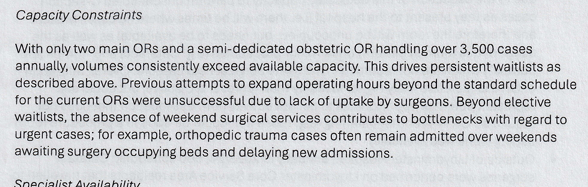
The hospital does not perform scheduled surgeries on weekends. The assessment identifies this as a direct contributor to surgical backlogs.
“The absence of weekend surgical services contributes to bottlenecks with regard to urgent cases,” the document states. “Orthopedic trauma cases often remain admitted over weekends awaiting surgery, occupying beds and delaying new admissions.”
A patient with a broken hip admitted Friday night waits in a hospital bed through Saturday and Sunday for a surgery that cannot happen until Monday. That bed is unavailable to anyone else for the entire weekend.
Allied health coverage, particularly physiotherapy, is also “limited after-hours and on weekends,” the assessment states, “unnecessarily prolonging inpatient stays, slowing inpatient throughput and reducing patient quality of care.”
The dual-jurisdiction barrier
Lloydminster’s surgical services face a structural problem other hospitals do not.
“Jurisdictional differences between Alberta and Saskatchewan create referral pathways that may limit some residents from receiving surgery at their preferred site, even when factors such as family or support networks make it the most appropriate option for patients,” the assessment states.
A patient on the Alberta side of the border may face a different referral pathway than a patient on the Saskatchewan side for the same surgeon at the same hospital. The assessment identifies this as an equity problem specific to Lloydminster that no other community in Canada faces.
What is coming by 2040
The assessment projects Lloydminster Hospital will need to perform approximately 5,600 annual surgical procedures by 2040, up from approximately 3,500 today.
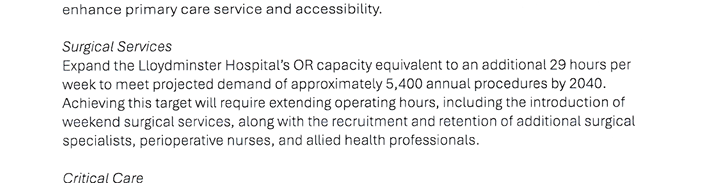
“The Lloydminster Hospital would require an expansion of OR capacity equivalent to an additional 29 hours per week to meet projected demand of approximately 5,400 annual procedures by 2040,” the assessment states.
That 29 hours is not a new building. It is extended weekday hours, the introduction of weekend surgical services, and the recruitment of additional surgical specialists and operating room nurses.
The assessment also recommends adding cataract surgery capacity on weekends, introducing urology services on site, and adding a Friday orthopedics slate to address current backlog.
By 2040, the hospital will also need approximately 10 surgical inpatient beds, one more than it has today.
This is not the first time the problem has been identified. A 2013 health assessment commissioned by the same two governments recommended expanding surgical services and increasing OR access at Lloydminster Hospital. Twelve years later, the waitlist has more than doubled and the operating rooms are running out of hours.
Government response
BorderPulse contacted the Saskatchewan Ministry of Health and the Alberta Ministry of Primary and Preventive Health Services with four specific questions about surgical services at Lloydminster Hospital. Dale Hunter, Senior Media Relations Consultant with the Saskatchewan Ministry of Health, responded on behalf of both provinces.
Hunter said the ministry is committed to improving care for Lloydminster residents and pointed to the province’s Patients First Health Care Plan as an existing framework for surgical improvement.
“The Saskatchewan Ministry of Health is committed to working closely with our Alberta counterparts to provide consistent, high-quality health care services for all residents in the Lloydminster catchment area,” Hunter said.
Hunter said the province is working to reduce surgical backlogs provincially, citing a commitment to perform 450,000 surgeries over four years, reduce wait times to 90 days, intensify recruitment of anesthesia professionals, and launch an improved surgical specialist directory.
Hunter also noted provincial surgical funding has increased significantly.
“The Saskatchewan Provincial Budget allocation for surgical procedures, capital and service enhancements under the surgical program has increased by approximately $170 million since 2007,” Hunter said. “There have been $100 million in permanent budget increases to the surgical program since 2020.”
The province’s 90-day surgical wait time target applies provincially. The assessment found between 20 and 30 per cent of Lloydminster patients waiting for surgery have already exceeded their diagnosis-based clinical target.
BorderPulse asked four questions. The response did not answer any of them directly.
The ministry did not address why Lloydminster Hospital’s surgical waitlist more than doubled in two years despite provincial surgical investment. It made no commitment to introduce weekend surgical services at Lloydminster Hospital, where orthopedic trauma patients currently wait in hospital beds from Friday to Monday because no scheduled surgery is available. It did not commit to funding the additional 29 OR hours per week the assessment identifies as necessary. It did not address the jurisdictional referral pathway inequities that prevent some Lloydminster-area residents from accessing surgery at their preferred site.
Tomorrow: Province’s justification for keeping report secret isn’t there
This is the next part in a multi-part investigative series revealing what they don’t want us to know about the Lloydminster Health Needs Assessment.
Read the whole series – Lloydminster Health Needs Assessment: Investigation