




A $262,260 health assessment reveals the full scope of who depends on Lloydminster’s hospital, and how little two governments have done to keep up.
Before you can understand what is broken, you need to understand how many people are counting on one hospital to not be broken.
The answer is more than most people know.




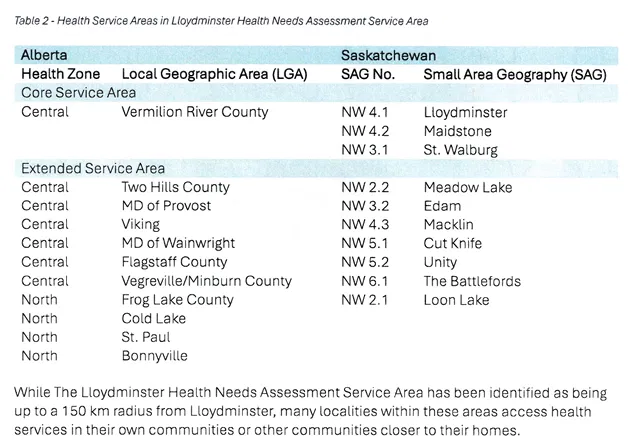
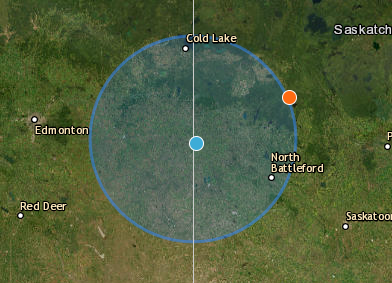
According to the Lloydminster Health Service Needs Assessment, the service area studied in the report “extends 150 kilometers from Lloydminster, encompassing numerous urban, rural, and Indigenous communities.” According to the 2021 Census, that 150-kilometre radius held approximately 217,000 residents.
Lloydminster Hospital serves them all.
The assessment defines this population in three zones. The Core Service Area, roughly a one-hour drive from Lloydminster, had a population of approximately 71,000 in 2024. The Extended Service Area stretches to 150 kilometres and is projected to reach approximately 241,505 people by 2040. The hospital’s direct catchment, defined by the Saskatchewan Health Authority as the number of patients who currently receive care there, is approximately 42,000 people.
The assessment explains the gap directly.
“Outside of the Core Service Area, the overall use of Lloydminster health services decreases, particularly with increased proximity to tertiary facilities in Edmonton and Saskatoon,” the document states.
People are going elsewhere. The assessment documents why.
Communities within the service area, including Maidstone, Lashburn, Turtleford, Vermilion, Kitscoty, and Marwayne, “are small and have limited access to healthcare services within the communities.” Smaller hospitals in the extended area have “a limited scope of services, leading to a dependency on regional facilities.”
Lloydminster is that regional facility. The assessment makes clear it is already under pressure.
The assessment identifies Indigenous residents as a population with particular needs. Indigenous people make up approximately 13 per cent of Lloydminster’s city population, including six per cent who identify as First Nations and seven per cent who identify as Metis. Within the Core Service Area, that proportion rises to 17 per cent. The extended service area includes more than a dozen First Nations reserves and Metis settlements, with the Indigenous population estimated at approximately 14 per cent on the Alberta side and 21 per cent on the Saskatchewan side.
The full assessment identifies “systemic barriers, such as transportation challenges, financial constraints, and limited availability of specialized services, that affect access, particularly in rural and marginalized communities.” It states the health system must strive for “equity in both access and outcomes,” with “a particular focus on underserved populations in Alberta and Saskatchewan.”
The four-page summary the government released to the public acknowledged that “Indigenous communities often face higher rates of chronic conditions, mental health challenges, and barriers to accessing culturally safe care.” It did not include the full document’s specific identification of systemic barriers, including transportation challenges, financial constraints, and limited availability of specialized services.
The summary also disclosed something the government did not highlight. The assessment “excluded planning for land-based Indigenous communities, as separate planning processes were underway in parallel, led by First Nations.”
In other words: a $262,260 assessment covering a catchment area that is up to 21 per cent Indigenous explicitly did not plan for Indigenous community health needs.
The population is also getting older, fast. The assessment projects the population aged 65 and over in the Core Service Area will increase from 10,116 in 2025 to 14,549 in 2040. That is a 44 per cent increase in senior residents in 15 years. The population aged 75 and over is projected to increase from 4,368 to 7,830 in the same period, a 79 per cent increase.
“The aging of the population will have substantial impacts on demand for Continuing Care, Home Care, and may subsequently have knock-on effects on demand for acute care services,” the assessment states.
More seniors means more hospital visits, more long-term care needs, and more pressure on a system the assessment has already identified as strained.
The assessment also flags something many residents on the Alberta side may not know. The Alberta side of the city is significantly older than the Saskatchewan side. Among all Lloydminster residents aged 65 and older, 77 per cent live on the Alberta side of the border, with only 23 per cent on the Saskatchewan side.
The hospital is on the Saskatchewan side.
Lloydminster’s location creates complications that no other community in Canada faces. The assessment describes a city where “planning, funding, and service delivery must be coordinated across two provincial systems,” and where “administrative complexity and coordination, fragmentation of systems, and regulatory inconsistencies” are daily realities.
It describes a community that is “the largest community between Edmonton, Alberta and Saskatoon, Saskatchewan,” sitting approximately 2.5 hours by vehicle from each.
If something goes seriously wrong here, the nearest major centre is two and a half hours away.
The assessment was completed in December 2025. Two governments received it. They released four pages.
Thursday July 3: Why does the assessment say newborns are being unnecessarily transferred from Lloydminster Hospital?
This is the next part in a multi-part investigative series revealing what they don’t want us to know about the Lloydminster Health Needs Assessment.
Read the whole series – Lloydminster Health Needs Assessment: Investigation