




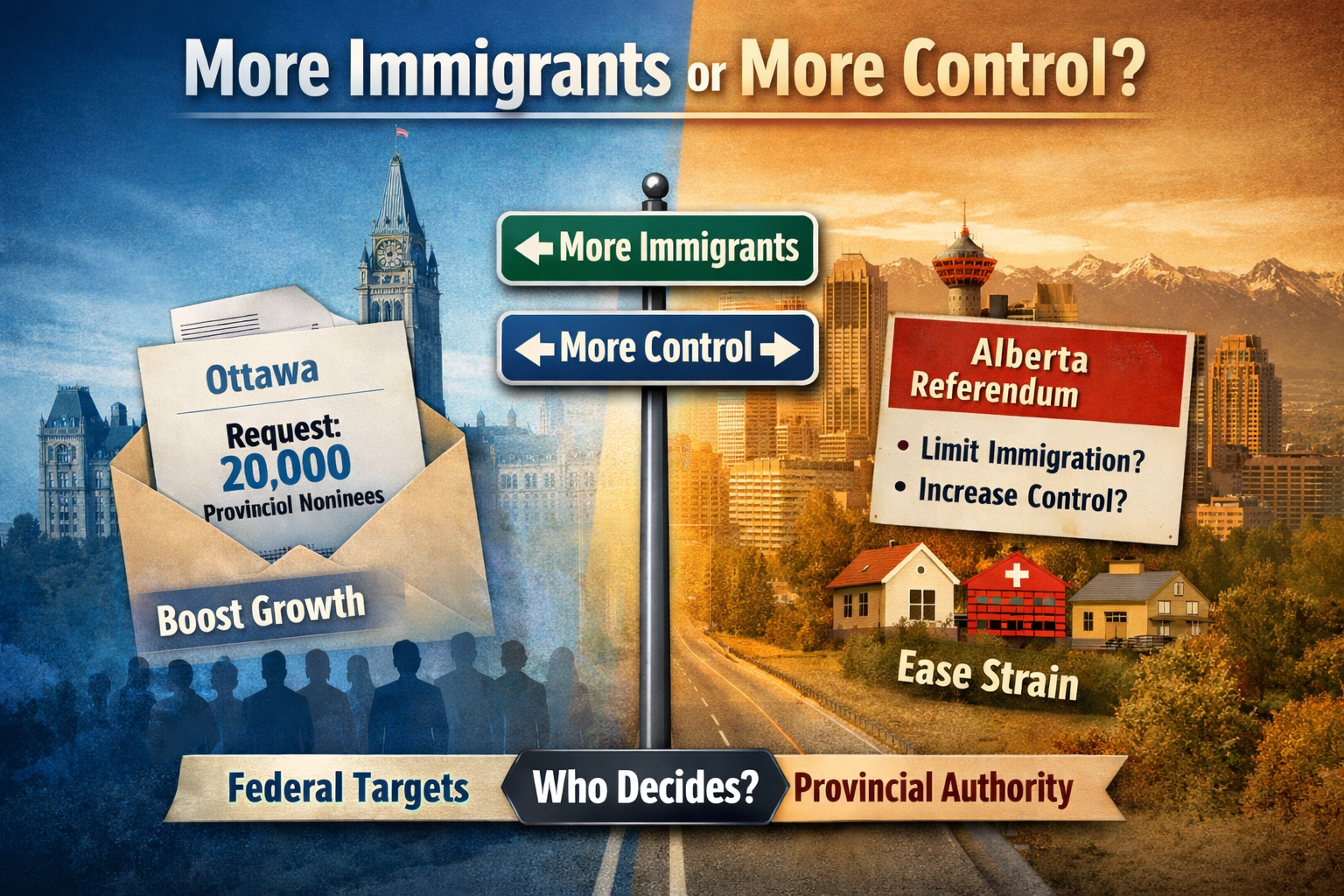
In 2024, Alberta Premier Danielle Smith wrote to then-prime minister Justin Trudeau arguing that federal immigration limits were holding the province back.
In that letter, she said Ottawa’s caps were “undermining Alberta’s economic growth” and requested “an annual allocation of 20,000 nominations for the Alberta Advantage Immigration Program for 2024–2026,” along with additional spaces to help Ukrainian evacuees transition to permanent residency.
Those are permanent resident spots. That was a request for more immigrants to Alberta, specifically economic immigrants selected by the province.




Last night, Smith announced a fall referendum ( see full video below ) that includes a question aimed at increasing Alberta’s control over the amount of immigrants we receive, and potentially decreasing those levels. In outlining the referendum, she said immigrant levels must better align with housing, infrastructure and public services, and that Alberta needs increased control over how immigration is managed.
At first glance, those positions may seem difficult to reconcile.
But the deeper thread running through both moments is not necessarily volume. It is authority.
Two systems operating at once
Immigrants, and control over them, functions on two levels in Canada.
The federal government sets overall national immigration targets. Provinces do not determine that total.
Within that national number, provinces receive allocations under the Provincial Nominee Program, allowing them to select immigrants tailored to their labour market needs.
When Alberta asked for 20,000 nominee spaces, it was not formally requesting a higher national immigration target. It was asking for a larger share of the existing total and greater provincial influence over selection.
That distinction is central to the current debate.
What changed?
Since that letter, Alberta has experienced rapid population growth from a combination of international immigration and interprovincial migration.
Housing supply has tightened. Rental costs have climbed. Health-care systems have faced capacity strain. Infrastructure planning has struggled to keep pace with demand.
The language has shifted accordingly.
In 2024, the emphasis was on labour shortages and economic expansion. Now, the emphasis is on capacity, alignment and provincial control.
The consistent theme in both cases is Alberta’s demand for a stronger role in determining how immigration affects the province.
The accountability gap
The structural tension is straightforward.
Ottawa sets immigration levels.
Provinces deliver housing, health care, schools and infrastructure.
When growth accelerates, provinces feel the service pressure. When labour markets tighten, provinces ask for more immigration flexibility.
Both realities can exist at the same time.
Alberta can argue that federal caps were limiting economic growth in 2023, while also arguing in 2026 that immigration levels must better match provincial capacity.
The friction emerges when population growth outpaces infrastructure planning.
The question ahead
The referendum is not legally binding on the federal government. Immigration remains primarily a federal responsibility under the Constitution.
Politically, however, it signals Alberta’s intent to seek more control over how immigration levels are set and aligned with provincial planning.
The core issue is not simply whether Alberta once asked for more immigrants and now wants fewer.
It is whether immigration policy, housing supply, infrastructure investment and fiscal transfers are being coordinated effectively across governments.
Until that coordination question is answered with clear data, the debate risks being driven more by rhetoric than systems analysis.
Read more: Smith Scorns Supreme Court sexual offences ruling










This is an excellent, clear presentation of the real issues surrounding what is very likely to become a simplistic “for or against immigration” response by many people ……